

The talent war in artificial intelligence has demolished conventional compensation packages. OpenAI, Anthropic, Google DeepMind, and Meta now routinely offer total packages exceeding $1 million annually for senior individual contributors, with the most sought-after researchers commanding tens of millions.
Although such high pay packages may seem excessive or a sign of market irrationality, they are not. It's basic economics. In an industry where a single breakthrough can generate billions in market value or establish decade-long competitive moats, the marginal product of elite AI talent vastly exceeds traditional salary bands. The resulting compensation ladder has created distortions throughout the broader technology labor market, as companies outside AI struggle to retain engineering talent and universities watch their most promising researchers depart for industry positions offering multiples of academic salaries.
Understanding this arms race involves analyzing both the microeconomic factors—such as the significant productivity gaps between leading and average AI practitioners—and the macroeconomic effects on innovation, inequality, and the geographic clustering of technology.
According to a recent report, OpenAI pays an average compensation of $1.5 million across its more than 4000 employees, topping the field by a large margin.
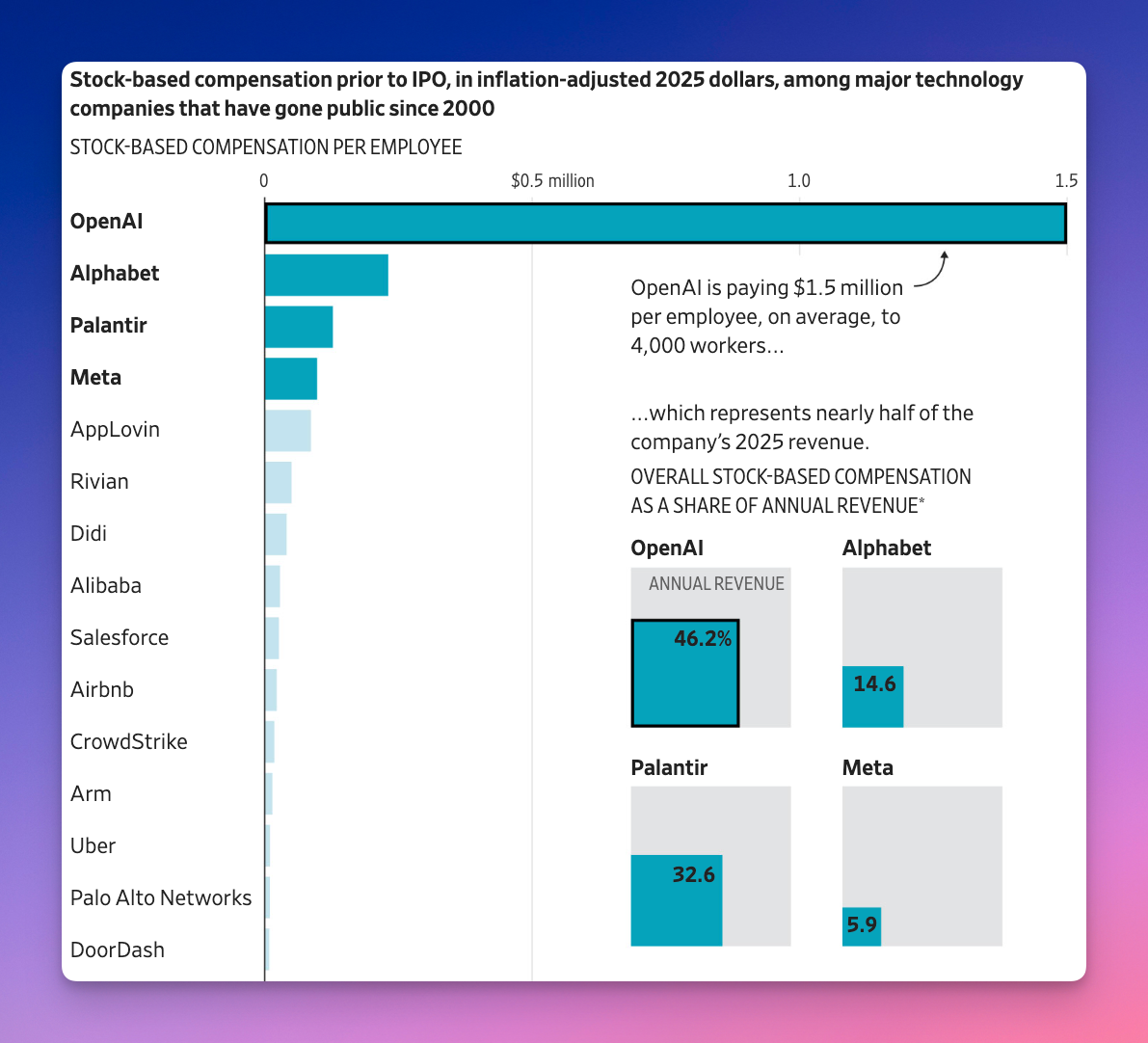
Although staggering, OpenAI's compensation figures don't fully reflect the value of some highly sought-after talent. For instance, Zuckerberg attempted to recruit some of OpenAI's founding members with pay packages exceeding $1.5 million over several years.
His chief target: Andrew Tulloch, a leading researcher and co-founder at the startup ... To peel him off, Zuckerberg dangled a billion-dollar package that could, with top bonuses and extraordinary stock performance, have been worth as much as $1.5 billion over at least six years, according to people familiar with the matter ... Tulloch said no.
Most people could never imagine a pay package worth $1.5 billion. But then again, most people are not the top talent in the top industry amid unprecedented investment.