How Maryland's Economy Compares
A decade of outperformance is tested
A short intelligence memo on Cities Infrastructure. Read for the core judgment, evidence trail, and decision implication.
A decade of outperformance is tested
- Frame
- Briefing
- Topic
- Cities Infrastructure
- Access
- Free
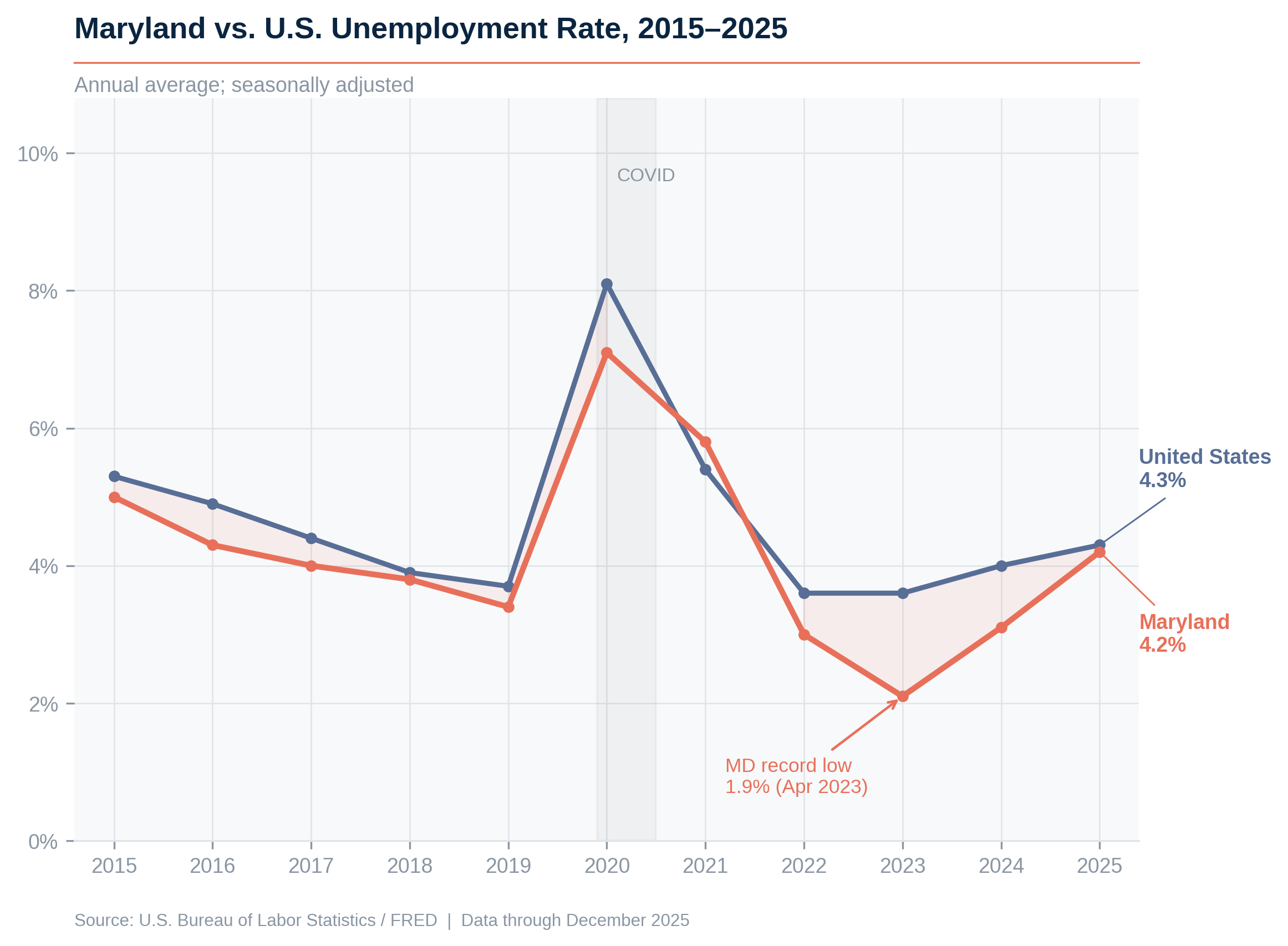
For most of the past decade, Maryland's outperformed national averages. While the national unemployment rate tracked its familiar arc — spiking in 2020, recovering through 2022, softening again through 2025 — Maryland consistently ran below it. In 2023, the state briefly touched 1.9% unemployment, the lowest annual average of any state on federal records going back to 1976.[1] Few outside the Baltimore-Washington corridor seemed to notice, but the numbers spoke for themselves.
They still do. But in 2025, what they say changed.
What Gives Maryland An Edge
Maryland is easy to underestimate. It is small by geography, mid-ranked by population, and routinely dismissed because of its relationship to the federal government. That dismissal has always been wrong — and the data shows why.
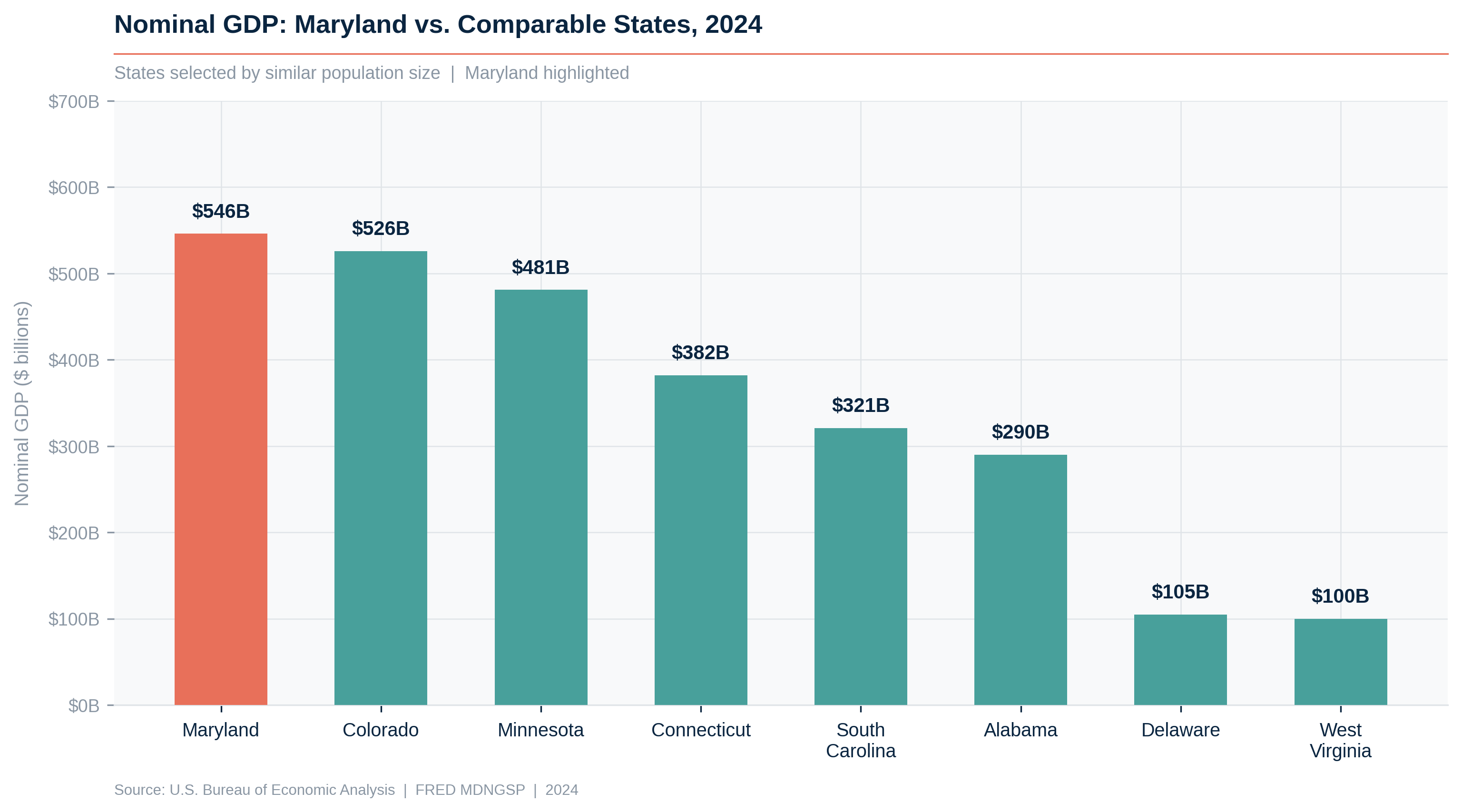
Maryland's nominal GDP reached $546 billion in 2024, placing it among the twenty largest state economies in the country.[2] That output is not commensurate with a population of roughly six million. Comparable states — Minnesota, Colorado, South Carolina — produce significantly less. The gap reflects something structural, not statistical.
The answer starts with education. Maryland ranks third among all states for educational attainment and sixth nationally for public school quality.[3][4] A state that reliably produces credentialed, skilled workers becomes a magnet for the employers who need them — federal agencies, defense contractors, cybersecurity firms, life sciences companies. The densest concentration of all four on the East Coast is not an accident of geography. It is the accumulated return on decades of workforce investment.
But that same logic contains a trap. The educated workforce that made Maryland an outperformer also made it dependent on the largest local employer, the federal government. Federal civilian jobs account for roughly 6% of Maryland's total employment, and federal wages, contracts, retirement income, and direct payments collectively channel more than $150 billion annually into the state economy.[5]
When Washington started to gut its civilian workforce, Maryland felt it first.
The Federal Shock
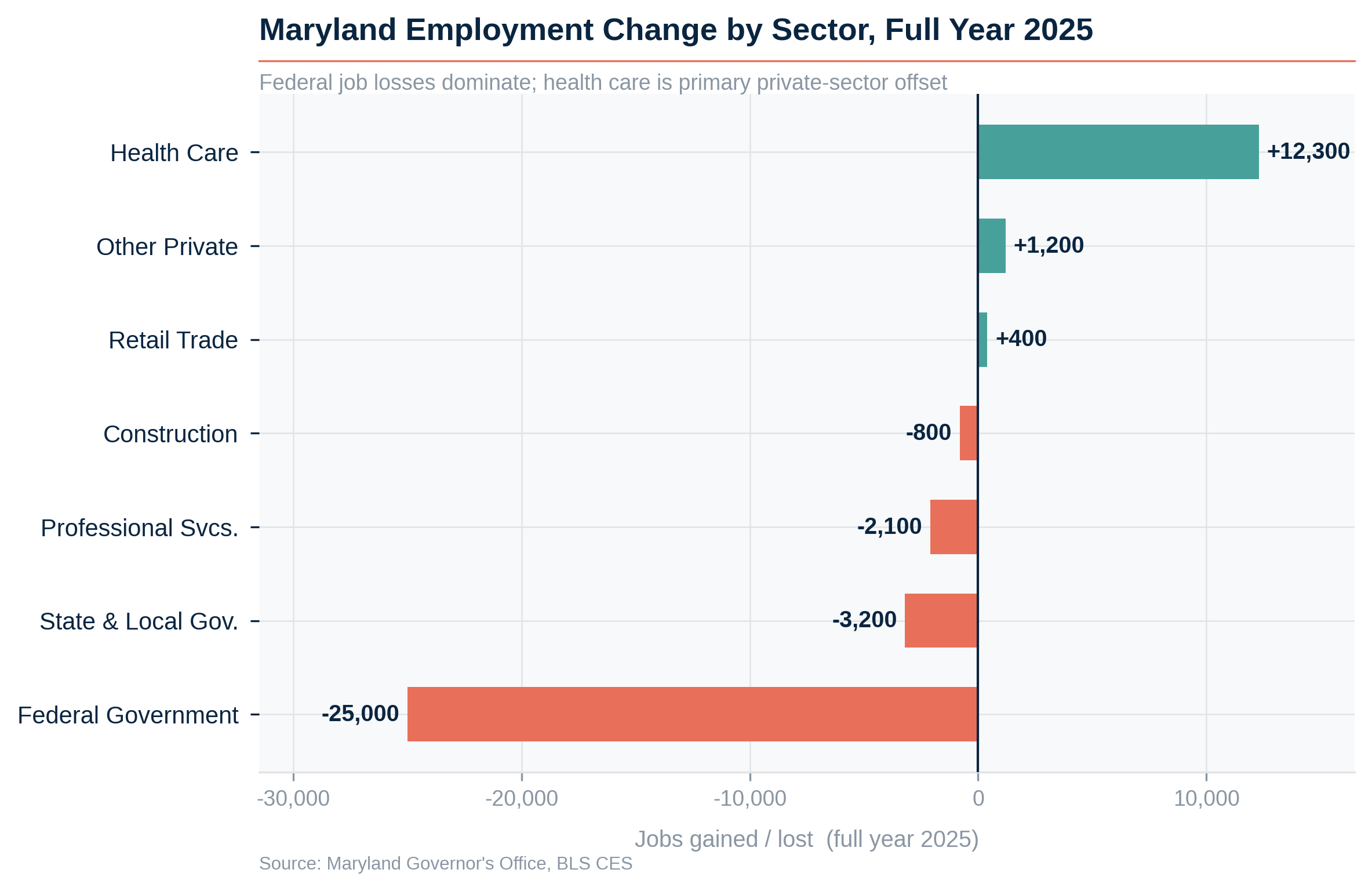
The Trump administration's federal workforce reductions arrived in waves: mass layoffs in early 2025, the deferred resignation program, a 43-day government shutdown in October and November — the longest in U.S. history. By year-end, Maryland had lost nearly 25,000 federal jobs, a 9% decline in its federal workforce and the largest such contraction of any state in the country.[6] The broader DMV region shed roughly 56,000 jobs total; 96% of those losses traced directly to federal cuts.[7]
The private sector absorbed some of the blow. Health care added 12,300 jobs across the year — more than any other sector, a reflection of the state's strong hospital and research base.[8] But the losses outnumbered the gains. Twelve thousand health care positions, typically paying $50,000–$70,000 annually, cannot replace twenty-five thousand federal jobs averaging well above $100,000. Purchasing power, tax revenue, and the household stability that federal employment anchored across suburban Maryland suffered.
The unemployment rate captures the result. Maryland climbed from 3.1% at the start of 2025 to 4.2% by December — a 1.1 percentage point increase in twelve months, among the sharpest state-level deteriorations in the country.[9] The state still sits marginally below the national average of 4.4%. For a state that spent years running a full percentage point or more below that mark, near-parity is not stability. The forces driving the decline are not cyclical — a recession that will lift, a rate cycle that will turn. They are deliberate policy choices, made in Washington, with no obvious reversal in sight.
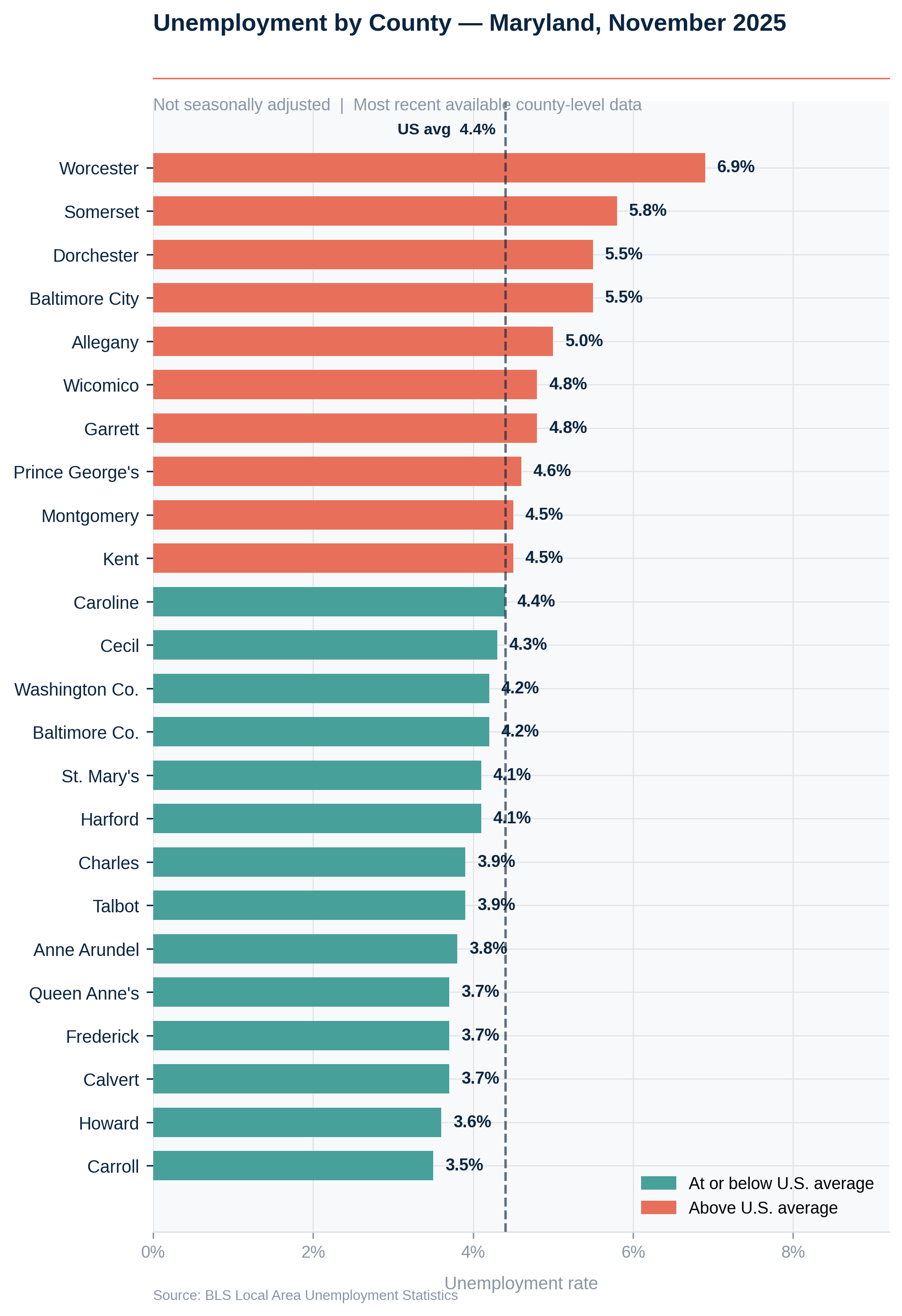
The geographic footprint of the damage maps almost exactly onto the federal employment footprint. Montgomery and Prince George's counties — which together hold the largest share of Maryland's federal workforce — both ended 2025 with unemployment rates above the national average.[10] Carroll County, in the exurban northwest, remained the state's tightest labor market at 3.5%. Worcester County on the Eastern Shore posted the highest rate at 6.9%.[11] The rural-suburban divergence is real, but it is secondary to the primary story: the counties most exposed to Washington are the counties most damaged by Washington.
What Holds, and What Doesn't
Maryland's structural advantages have not evaporated. A workforce that ranks third nationally in educational attainment does not become less educated because federal hiring freezes. The universities, hospitals, and research institutions anchoring Baltimore and the DC suburbs have no relocated. The decades of investment in public education that built the state's labor market reputation are still there.
What is less certain is whether those advantages provide sufficient insulation against a sustained, intentional contraction of the state's largest economic relationship. Governor Moore's administration has responded with job placement centers, buyout incentives, and a push to channel displaced federal workers into state and local government roles.[12] These are sensible responses. They are also responses to a problem that is still growing — updated state-level employment data for January and February 2026 will not be released until April, delayed by the same federal shutdown that triggered the job losses in the first place.[13]
Maryland has demonstrated that a small, well-educated state can outperform an economy of a state with a larger population. That record is real. What 2025 revealed is that the foundation underneath it was more exposed than the headline numbers suggested — and that exposure was always one policy decision away from becoming a liability.
The structural bet Maryland made over decades — invest in education, attract federal and institutional employers, build a high-wage knowledge economy — was the right bet. The question 2026 will begin to answer is whether that bet can survive when the institution it was partly built to support dramatically shrinks its workforce.
Notes
CNN Business. "Maryland has the lowest unemployment rate in American history, at just 1.6%." November 15, 2023. Maryland's seasonally adjusted rate reached 1.6% in September 2023, the lowest of any state on BLS records dating to 1976. The 1.9% figure cited is the annual average low. https://www.cnn.com/2023/11/15/economy/maryland-lowest-unemployment-rate-ever/index.html ↩︎
U.S. Bureau of Economic Analysis. Gross Domestic Product by State, 2024. Maryland nominal GDP: $546.0 billion (FRED series MDNGSP). Federal Reserve Bank of St. Louis. Updated September 26, 2025. https://fred.stlouisfed.org/series/MDNGSP ↩︎
WalletHub. Most Educated States in America, 2025. Rankings based on educational attainment, school quality, and achievement gaps. Maryland ranked 3rd overall. https://msa.maryland.gov/msa/mdmanual/01glance/html/edelem.html ↩︎
World Population Review. Public School Rankings by State, 2026. Maryland ranked 6th nationally, with an average ACT score of 22.3 and average SAT score of 1058. https://worldpopulationreview.com/state-rankings/public-school-rankings-by-state ↩︎
CBS Baltimore, citing Maryland Governor's Office and Office of the Comptroller. "Nearly 25,000 federal workers in Maryland lost their jobs in 2025, data shows." January 8, 2026. Federal employment accounts for approximately 6% of Maryland's workforce; federal wages, contracts, retirement income, and direct payments total more than $150 billion annually. https://www.cbsnews.com/baltimore/news/maryland-unemployment-job-losses-federal-workers-economy-2025/ ↩︎
Maryland Matters. "Maryland lost almost 15,000 federal jobs in 2025, a 9% drop in the workforce, state data shows." December 31, 2025. The state's federal employment fell from an estimated 163,100 in January to approximately 148,500 by September; updated figures from the Governor's Office place the full-year total at nearly 25,000 losses. https://marylandmatters.org/2025/12/31/maryland-lost-almost-15000-federal-jobs-in-2025-a-9-drop-in-the-workforce-state-data-shows/ ↩︎
Brookings Institution. "After the 'fork': Greater Washington leads the nation in regional job loss." March 2026. The DMV region ended 2025 with around 56,000 fewer jobs than the prior year; approximately 54,000 (96%) stemmed directly from federal layoffs. https://www.brookings.edu/articles/after-the-fork-greater-washington-leads-the-nation-in-regional-job-loss/ ↩︎
Office of Governor Wes Moore. "New Employment Data Reveal Trump Firings Have Cost Maryland Nearly 25,000 Federal Jobs in 2025." Press release, January 8, 2026. Health care and social assistance added 12,300 positions in 2025, the largest private-sector gain of any industry in the state. https://governor.maryland.gov/news/press/pages/New-Employment-Data-Reveal-Trump-Firings-Have-Cost-Maryland-Nearly-25,000-Federal-Jobs-in-2025,-with-10,300-Federal-Jobs-Lo.aspx ↩︎
USAFacts, citing U.S. Bureau of Labor Statistics. "What is the unemployment rate in Maryland right now?" Updated February 2, 2026. Maryland's seasonally adjusted rate was approximately 4.2% in December 2025, up 1.1 percentage points year-over-year. See also FRED series MDUR. https://usafacts.org/answers/what-is-the-unemployment-rate/state/maryland/ ↩︎
U.S. Bureau of Labor Statistics. State Employment and Unemployment — December 2025. Released January 27, 2026. USDL-26-0117. Maryland statewide rate: 4.2% (SA). Montgomery County: 4.5%; Prince George's County: 4.6% (November 2025, NSA). https://www.bls.gov/news.release/laus.nr0.htm ↩︎
USAFacts, citing BLS Local Area Unemployment Statistics. County-level data for Maryland, November 2025. Carroll County: 3.5% (lowest in state); Worcester County: 6.9% (highest in state). https://usafacts.org/answers/what-is-the-unemployment-rate/state/maryland/ ↩︎
Maryland.gov. "Maryland Workers Impacted by Recent Federal Actions." Governor Moore announced expanded support on February 28, 2026, including 33 American Job Centers, a Professional Outplacement Assistance Center, and weekly workshops attended by more than 2,000 displaced workers. https://response.maryland.gov/federalpublicservants ↩︎
Maryland Department of Labor, Office of Workforce Information and Performance. "Maryland Employment and Unemployment Press Release Schedule." State and substate releases for January and February 2026 are delayed due to the October 2025 federal shutdown and annual revision requirements. Full releases scheduled for April 2026. https://labor.maryland.gov/lmi/employmentsituation/releasedate.shtml ↩︎