

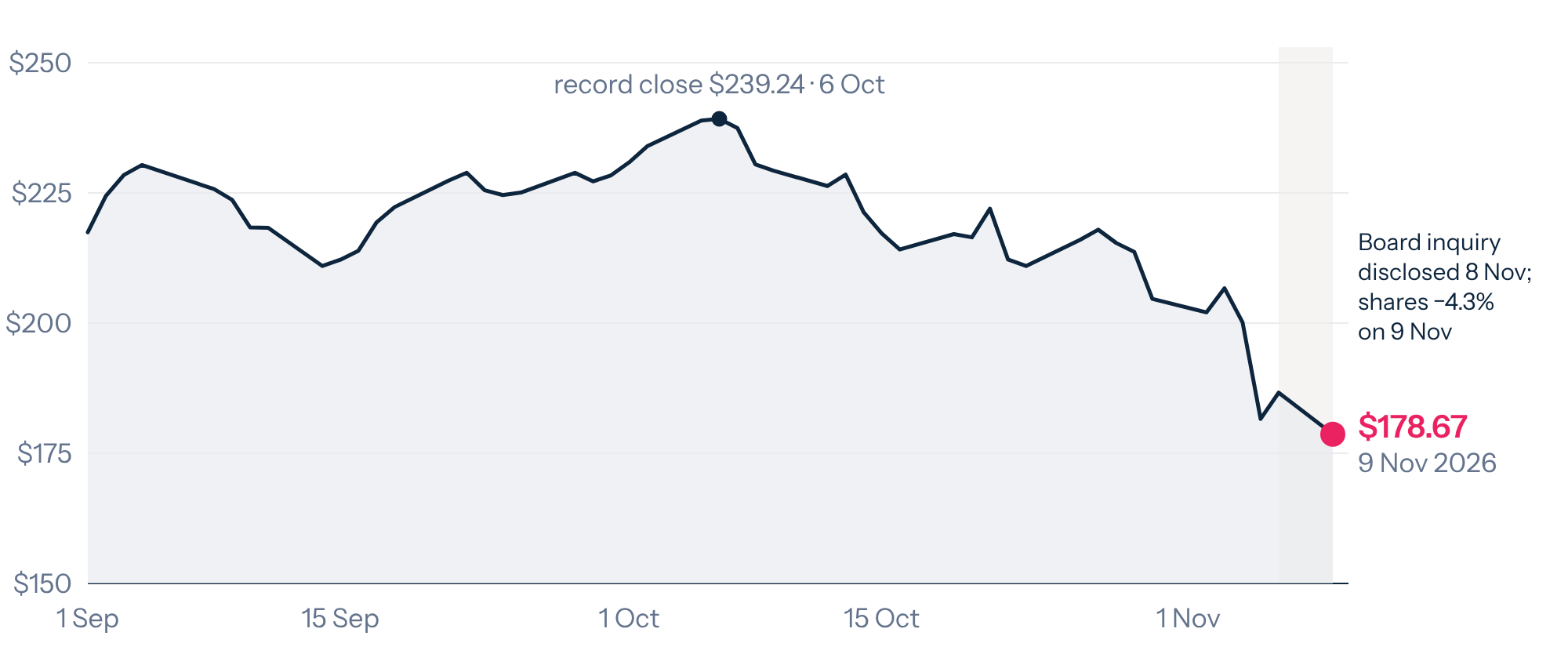
When a single counterintelligence probe wipes $193 billion off Nvidia’s value in one trading session, it suggests the market has fundamentally mis-priced a geopolitical risk. On November 9th shares in Nvidia fell by 4.3%, to $178.67, after the firm’s board opened an investigation into its chief executive, Jensen Huang.1 The inquiry centers on Mr. Huang’s undisclosed relationship with a reported Chinese intelligence asset. The crisis indicates that the contest over advanced artificial-intelligence chips has shifted from a game of geographic export controls to one of executive access. America’s supply chain has a glaring vulnerability at its apex.
American officials have identified the asset as a senior executive at Megaspeed, a Singapore-based technology firm. Nvidia’s board was quick to defend the integrity of its trade secrets, while Beijing summarily dismissed the allegations as baseless.23 Yet Nvidia’s defense is missing the point. By focusing its efforts on the boss of the world’s second-most-valuable company, a firm at the center of a complex web of trade restrictions, Chinese intelligence was targeting the broader American trade-policy framework that dictates how many chips China is allowed to buy in the first place.
Beijing courts the seller while Washington tracks the silicon
Traditionally, export controls have relied on geography: they track where a server is sold. It is a design that Megaspeed has reportedly exploited to great effect through its international subsidiaries. Between June 2024 and February 2026, Megaspeed's Malaysian sister company bought some $4.8 billion worth of equipment containing Nvidia chips. When officials from the U.S. Commerce Department visited the site, they found the gear still wrapped in boxes.2 For Beijing’s spies, smuggling hardware was evidently a sideshow. The strategic prize was shaping the policy process itself.
During the second Trump administration, Mr. Huang successfully lobbied to reopen chip sales to China in exchange for handing the federal government a 25% cut of the revenues.2 Washington subsequently cleared dozens of Chinese firms to handle Nvidia chips, some of them tied to companies under U.S. sanctions.4 For a foreign intelligence service, monitoring the executive who has the ear of the American president on technology policy provides unparalleled strategic foresight. Such an operation secures access at the very source of regulation, and it trips no alarms.
Old defenses guard the lab while the risk sits in the boardroom
America’s counterintelligence-focused economic defenses were built for a different era. Policies designed to thwart industrial espionage are largely geared towards prosecuting lower-level theft from individual firms. When Sinovel recruited an automation engineer to steal turbine software from American Superconductor, or when conspirators sold DuPont’s titanium-dioxide technology to companies controlled by the Chinese government, the federal government responded by hardening network perimeters, restricting access to sensitive laboratories, and strengthening screenings for new hires.56 These mechanisms are perfectly sensible for guarding intellectual property from electronic theft. They collapse entirely against an American chief executive shaping policy from the Oval Office.
If you hold a federal security clearance, American rules require you to report any continuing relationships with foreign nationals that involve bonds of affection or personal obligation.7 Millions of Americans adhere to this standard. Yet the top executives of firms selling the world’s most strategically vital hardware face no comparable requirement to disclose foreign contacts. The highest echelons of the most strategically important industry operate entirely unmonitored.
American intelligence did its job. Over the past year, U.S. intelligence identified the asset, surveilled the relationship, and briefed the president. Marco Rubio, the secretary of state, even drafted a memo this spring warning officials about the foreign contact.8 Yet, as reporting suggests, the executive branch appears to have stalled ensuing Commerce Department investigations in order to protect a favored corporate relationship.2 A White House that traded chip access for a 25% revenue cut chose to prioritize its corporate ties over explicit warnings from its own intelligence services, leaving the threat to fester for a year.
Congress moves the perimeter to the executive suite
The reckoning now moves to Capitol Hill. Senator Chris Coons, who takes the gavel of the Senate Foreign Relations Committee in January, has promised a full inquiry.8 Senator Elizabeth Warren, a Democrat from Massachusetts, is pressing for tighter export oversight. The administration is even reportedly weighing a return to limits on Southeast Asian data centers.4 Mr. Huang faces a high-profile closed-door hearing, an ordeal that will transform every export license Nvidia seeks into a referendum on its boss's judgment.2 For the company, a close relationship with Donald Trump has suddenly shifted from an invaluable corporate asset to a strategic liability as Democrats take power in Washington.
For investors, the 11-point gap between Nvidia’s slide and a rising chip index on November 9th represents a pure governance discount. The market is waking up to the danger of a firm whose future depends so heavily on one man’s standing in Washington. The incoming Democratic Congress should plan to extend foreign-contact reporting mandates to the senior executives of any firm exporting advanced AI chips. Corporate boards should proactively require their senior teams to disclose significant foreign relationships to an independent committee tasked with FBI referrals.
When the next raft of export rules arrives in 2027, it will have to reach past the hardware and start governing the executives who sell it.