

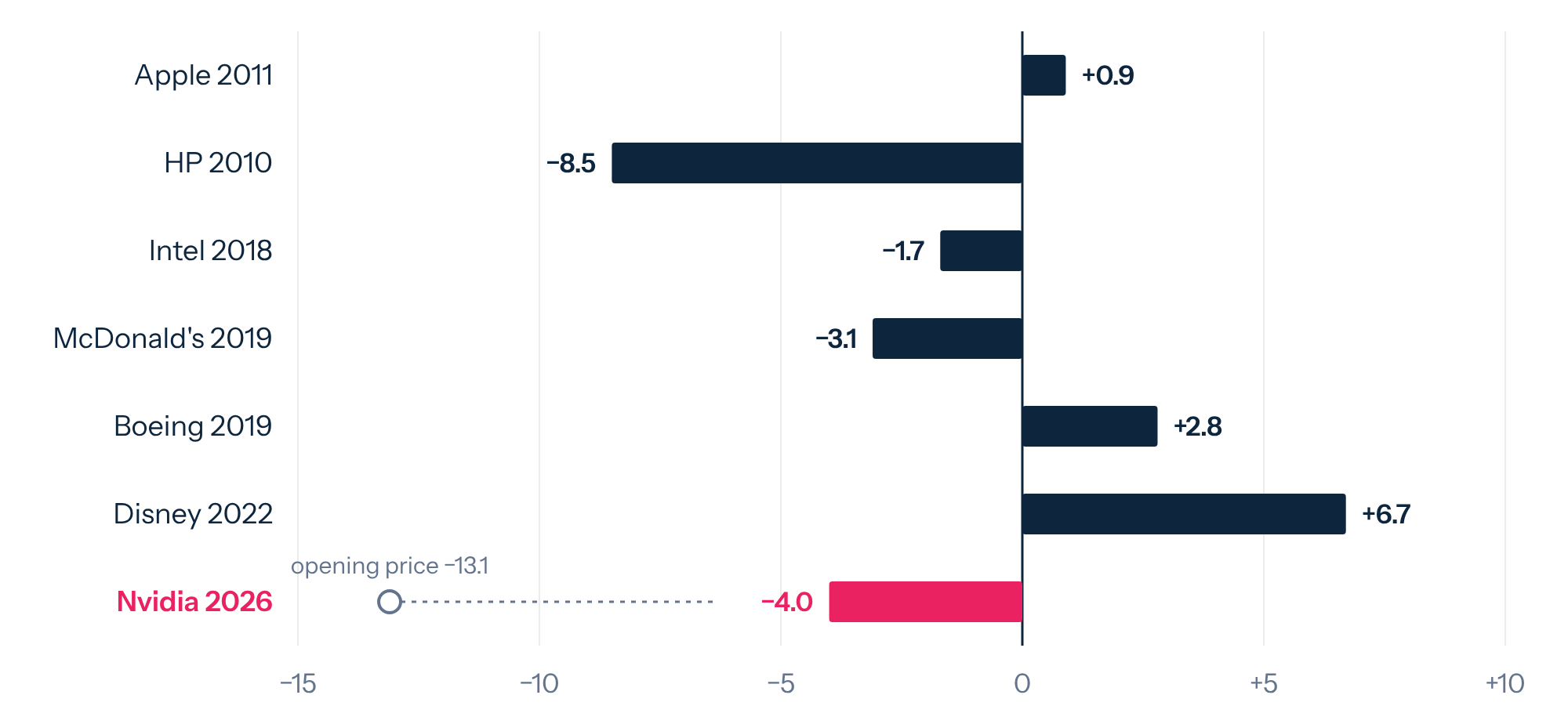
Nvidia's shares opened on November 12th at $151.01, 13.1% below the previous close, after the board announced that Jensen Huang had resigned as chief executive with immediate effect. By market close, buyers had recovered most of the loss with the stock ending 4.3% down at $166.19, against a 0.4% fall in the S&P 500.1 Investors spent the morning pricing the end of a 33-year founder tenure and the afternoon deciding they had overreacted. The historic record of sudden exits at large American firms says they underreacted. In five of the six cases examined here, the gap that opened against the market over the following year was wider than the first day's change, and in four it was several times wider. Nvidia's board acted quickly, but did they make the right move?
Mr. Huang co-founded Nvidia in 1993, building it into one of the most highly valued companies in the world, worth about $4 trillion.2 He resigned four days after the board opened an inquiry into his relationship with a woman American intelligence officials believe was an asset for China's Ministry of State Security. Reports of a second affair, with an Nvidia executive who worked under him, followed one day before his resignation was announced.2 The espionage case, and its stakes for export policy, was detailed in our recent essay, "Beijing Springs the Silicon Trap." The board made Colette Kress, the chief financial officer, interim chief executive while it conducts a broad search for a permanent one.3 Hewlett-Packard in 2010 and Intel in 2018 made the same choice, and a year later both trailed the S&P 500 by double digits.
First-day moves understate the risks
Six sudden exits from large American firms since 2010 provide historical context; in each, the successor took over a public company with industry standing and market power. Exhibit 1 sets each stock's first-day move against the S&P 500. Hewlett-Packard fell 8.5 points behind the market when Mark Hurd left in August 2010 over expense reports that, the board said, concealed a relationship with a contractor.4 Disney rose 6.7 points when Bob Iger returned to replace Bob Chapek in November 2022, and Boeing rose 2.8 points when its board fired Dennis Muilenburg in December 2019.5 McDonald's, which fired Steve Easterbrook over a relationship with an employee, slipped 3.1 points.6 The market response was split, rewarding three of these changes and marking down the three others.
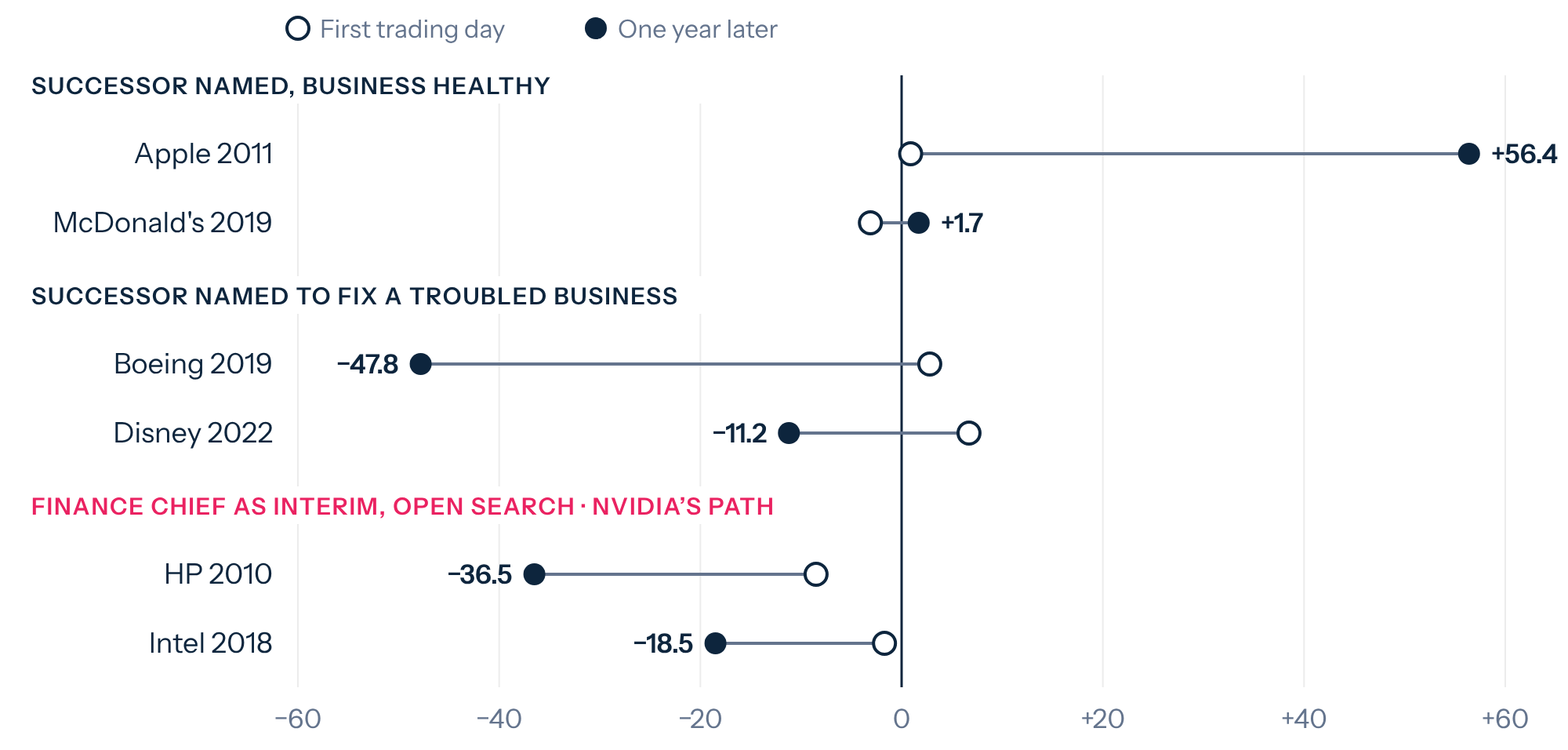
What happened over a year tells a different story. Exhibit 2 below sets each first-day move beside the stock's performance against the S&P 500 a year later. The first day called the direction of the year in only three cases of six, and in five it understated the size, four of them several times over. Disney, cheered on day one, trailed the index by 11 points a year later. Boeing, also up on day one, trailed by 48 points. HP's 8.5-point loss became a 36.5-point one, and Apple's gain of under a point became 56.
Markets have become better at pricing the chief executive. Timothy Quigley, Craig Crossland, and Robert Campbell studied 240 sudden deaths of American chief executives between 1950 and 2009 and found that the size of the market's reaction, up or down, grew markedly over those decades.7 Investors have not learned to price the succession, though. On day one, the market marks the loss of a person. Over the following year, more is discovered, disclosed, and dissected.
Firms that named an heir beat firms that searched
If you sort the six cases by what each board did on the day of change, as Exhibit 2 does, the stock price story is fairly consistent. Apple and McDonald's named a permanent successor, from inside the company, within hours. When Steve Jobs resigned in August 2011, Apple said he had urged the board to name Tim Cook per the succession plan, and the board did so the same day.8 McDonald's named Chris Kempczinski, head of its American business, in the same statement that dismissed Mr. Easterbrook.6 Apple beat the S&P 500 by 56 points over the next year; McDonald's beat it by two.
HP and Intel did what Nvidia has just done. Each made its finance director interim chief executive while launching a wide-ranging search. HP installed Cathie Lesjak, who ruled herself out of the permanent job,4 before the board hired Léo Apotheker, an outsider, and fired him 11 months later, when HP was worth about $60 billion less than on the day Mr. Hurd left.9 Intel made Bob Swan interim chief executive when Brian Krzanich resigned in June 2018, spent seven months searching, and then gave the permanent job to the man already doing it.10 Within four days, Nomura Instinet had downgraded the shares, citing a lack of leadership.11 An interim chief can keep the books and reassure customers, but lacks a strategic mandate if key decisions can be unwound months later by their successor. Firms with interim hires drift while their rivals gain market share.
Boeing and Disney offer different evidence since each changed its boss to rescue a business already in trouble. Boeing responded after regulators grounded the 737 MAX, a disaster no chief executive could fix in a year.5 A successor matters most when the business is sound, because then the leader's judgment is the main thing that can go wrong.
Six public companies do not constitute an immutable pattern, but they do provide historical context worth considering. The starting point for each firm matters, a large stock can swing 20 points against the index in a year with no change of boss, and Boeing's experience was complicated by the Covid-19 pandemic. Intel had told investors two months before Mr. Krzanich left that its next generation of chips would slip to 2019, so its lag owes something to the previous regime.12 This pattern is reinforced by independent research. Gary Ballinger and Jeremy Marcel found that American public companies which install an interim chief executive perform worse while the interim serves, and the leadership disruption can persist after the board names a permanent successor.13
Huang made himself the succession plan
The one founder exit in the sample went best because the founder prepared it. Mr. Cook was a senior Apple executive, and had run Apple's day-to-day operations during Mr. Jobs's medical leave, so the board executed the strategic change with known entities.14 Mr. Huang left no such plan. Asked by Bloomberg in mid-October about succession, he said he hoped "the next CEO of the company is already at the company, but 20 years from now."2 Nvidia's board appointed the first chair in the company's history, Harvey Jones, a former chief executive of Synopsys, on the day Mr. Huang left.3 There is no clearer signal to investors that little thought has been given to life after Mr. Huang.
Private firms pay for unplanned exits too
Two private companies, with no share price to give a daily verdict, show what a founder's unplanned exit costs. OpenAI shows how quickly the staff can overrule a board. When OpenAI's board fired Sam Altman in November 2023, more than 700 of its roughly 770 staff signed a letter threatening to leave; Mr. Altman returned to his position within five days.15 In a firm built on world-class technical talent, the engineers often hold the only veto over the board's choice. Nvidia's chip architects will judge their next boss as surely as OpenAI's researchers judged theirs. Unhappy staff will find open arms at Nvidia's more stable rivals.
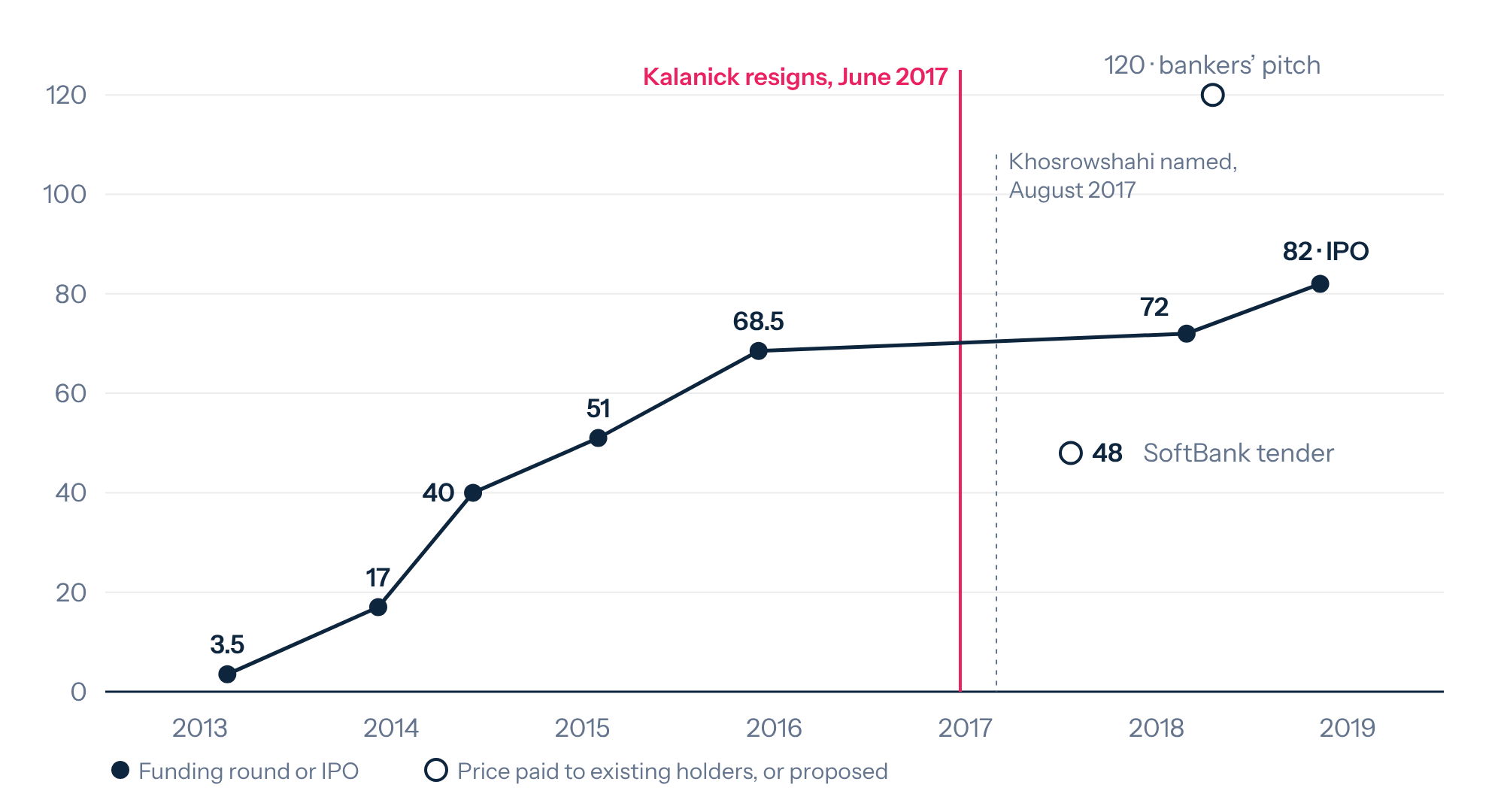
Uber shows the cost in value. Even while the business was growing, including funding rounds in 2016 that valued Uber at $68.5 billion, shareholders forced Travis Kalanick out as chief executive in June 2017. In the five months before he left, Uber's share of American ride-hailing spending fell from 84% to 77%.16 With no successor in waiting, the board took two months to hire Dara Khosrowshahi from Expedia.17 The first arm's-length price for existing shares that followed was about 30% lower when SoftBank bought its stake at an implied $48 billion.16 In August 2018, a year into Mr. Khosrowshahi's tenure, investors valued Uber at $72 billion. In May 2019, as it was going public, Uber was priced at $82 billion, a third below the $120 billion that Wall Street had pitched seven months earlier.18 Exhibit 3 traces the path. On November 9th, three days before Mr. Huang's resignation was announced, Mr. Kalanick posted twelve "practical principles to counter a modern-day coup" without naming anyone.19 In his thread, Kalanick counsels purging the disloyal and running a war room. Mr. Huang chose the opposite course.
Nvidia's Caretaker Inherits The Good and Bad
The bullish case for Nvidia is that its technology, not its executive, is the reason for its $4 trillion valuation. Yet the firm's technology, including the chips Nvidia will ship in in 2027, is a legacy of decisions Mr. Huang made years ago. The next set of critical decisions, how much manufacturing capacity to reserve at TSMC, how to respond to customers that are designing their own chips, and how to rebuild Nvidia's standing in Washington, will be made by the caretaker regime. The finance chief turned interim executive can make those decisions, but does so without the confidence of a strategic mandate. If Ms. Kress is appointed as the permanent replacement for Mr. Huang, Nvidia will be following Intel's playbook, choosing an insider confirmed after months of interim-led drift.
Washington is a complicating factor unique to Nvidia. The Republican chairs of three House committees had already asked Mr. Huang to brief them on the alleged Chinese espionage case, and he has agreed to testify despite his resignation. Democrats, who take control of Congress in January, are likely to make Mr. Huang's relationships, and what the White House knew of them, the subject of a wide-ranging inquiry.20 Since Nvidia's export licenses depend on the trust of officials now investigating circumstances surrounding the firm, there is no reason to believe Nvidia's future looks brighter than the day before the scandal broke.
What investors should watch
This confluence of events gives the board diverging priorities. Its engineers may trust an effective insider, but pressure from Washington will signal the importance of a fresh start with someone untainted by the scandals that engulfed Mr. Huang.
We will soon learn where the markets land. Nvidia reports its quarterly results on November 17th, but the numbers, which will certainly be strong, will reflect revenue generated under Mr. Huang.3 Investors should watch three things. The first is whether the board names Ms. Kress a candidate. The second is whether senior engineers start to leave in the coming weeks and months. The third is whether the eventual choice carries standing in Silicon Valley and, as important, Washington.
Every board with a founder still in charge, and there are many, especially among the large tech firms, should learn a simple lesson. As Apple demonstrated, succession planning works because the critical decision is settled before a crisis emerges. Nvidia's board will be judged within a year, and the precedents say the risk is much larger than what the markets have priced thus far.