

In the winter of 2021, eight researchers left OpenAI convinced that the race to build artificial general intelligence was moving too fast, with too few guardrails, and too much concentrated power. Led by siblings Dario and Daniela Amodei, the breakaway faction founded Anthropic to counter Silicon Valley’s speed-above-all ethos.1 They incorporated Anthropic in Delaware as a Public Benefit Corporation, wrote the long-term benefit of humanity into its charter, and seven of them pledged to give away most of their equity in the company.2 Their company now asks public investors for $100 billion at a valuation of up to $2 trillion.3 Its S-1 leaves the levers over that bet with its cloud suppliers, the Commerce Department, and seven founders and a trust.
On October 26, 2026, Anthropic filed a 318-page Form S-1 to list on the Nasdaq under the ticker ANT.3 The filing is the blueprint for what would be the largest IPO on record, which aims to raise $100 billion or more during the week of November 16 at a valuation between $1.5 trillion and $2 trillion.3 That would top the $75 billion SpaceX raised in June at a $1.75 trillion valuation.3 Goldman Sachs and Morgan Stanley, the lead underwriters on SpaceX, will reprise those roles on Anthropic’s November roadshow.3
Revenue is compounding on software margins, and more than half the Fortune 500 now spend at least $100,000 a year on Claude.2 Yet Anthropic spends four times as much building models as serving customers.2 It also owes more than a quarter-trillion dollars in take-or-pay cloud obligations to companies it competes with.2 To comply with Commerce Department export restrictions, it switched off two of its newest models for every customer in June.2
Paper losses bury a second-quarter operating profit
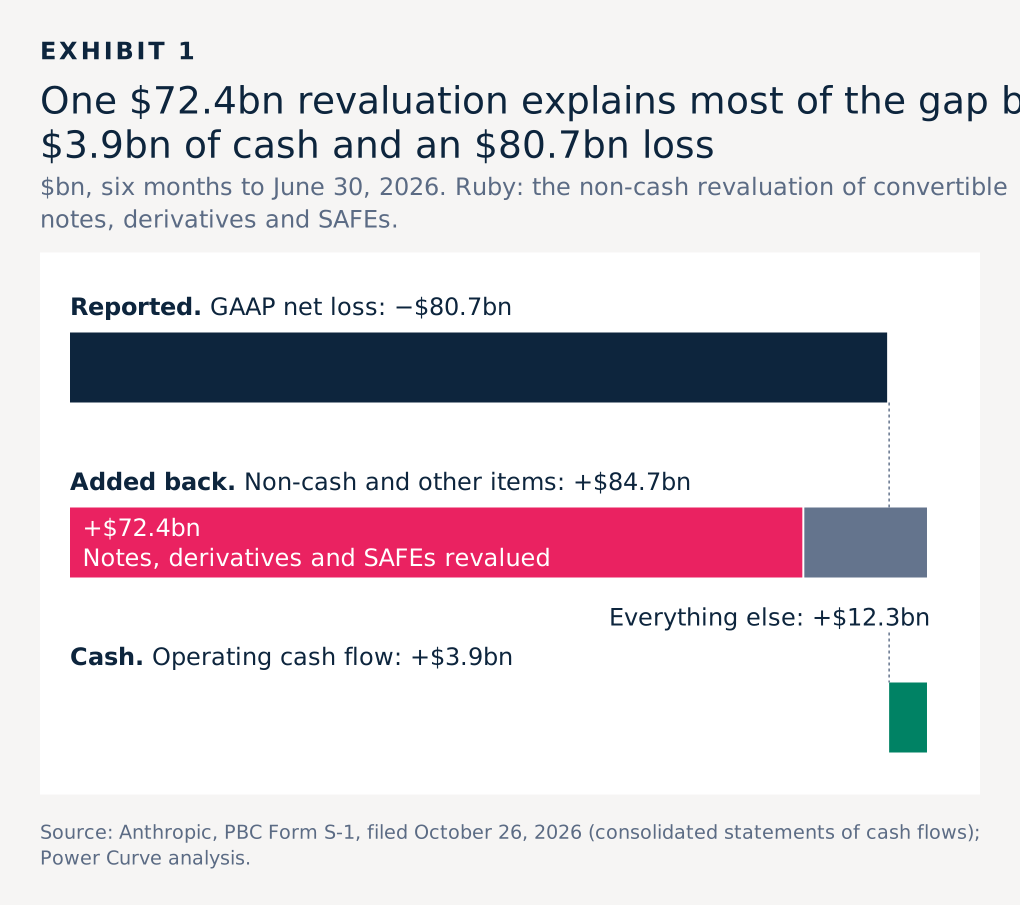
Investors on the November roadshow will see a net loss of $80.7 billion for the first six months of 2026, up from $13 billion a year earlier.2
Of that loss, $72.4 billion never left Anthropic’s bank accounts.2 It is a non-cash charge on the convertible notes and other financing instruments the company signed in its private fundraising rounds, most notably Amazon’s convertible debt, first issued in 2023.2 Anthropic’s private valuation compounded over the past two years, through its Series H round in May and June 2026.2 Under generally accepted accounting principles, the company had to record the rising fair value of its backers’ convertible paper as an expense.2 Another $8.8 billion of other expense came mainly from recognizing and revaluing the assets and liabilities under its note purchase agreements, partly offset by $1.1 billion of interest income.2
Underneath the paper loss, the operating business turned profitable in the second quarter. Revenue rose from $41 million in 2023 to $16.3 billion in the first half of 2026 alone, and more than doubled between the first and second quarters.2 A $1.67 billion operating loss in the first quarter gave way to a $974 million operating profit in the second, which cut the half-year operating loss to $693 million.2 Operating cash flow for the half was $3.9 billion.2 That revenue is concentrated: two customers supplied nearly a quarter of 2025 revenue, and one supplied 11 percent in the first half of 2026.2 Over the nine months to September, no customer topped 10 percent, but the top five supplied about 25 percent.2
In 2025, Anthropic stopped reporting "cost of revenue" and "gross profit" as separate line items on its income statement, and the figures now sit in a footnote.2 They show a business that earns like software and spends like a laboratory. Serving customers cost $2.4 billion in the first half of 2026, a gross margin of about 85 percent on $16.3 billion of revenue, while research and development, mostly compute for building models, cost $9.7 billion.2 Anthropic buys that compute from companies that include Google and Amazon, the same companies that finance it.2
$269 billion cloud bill owed to rivals
Anthropic holds $131.7 billion in cash and short-term investments after raising $141.1 billion since 2021.2 Yet it still expanded its secured revolving credit facility to $15 billion in September, carries $6.2 billion in convertible debt held by Amazon, and is now selling stock.2 The prospectus says it took on debt to fund its compute commitments and will spend part of the IPO proceeds on compute and infrastructure.2
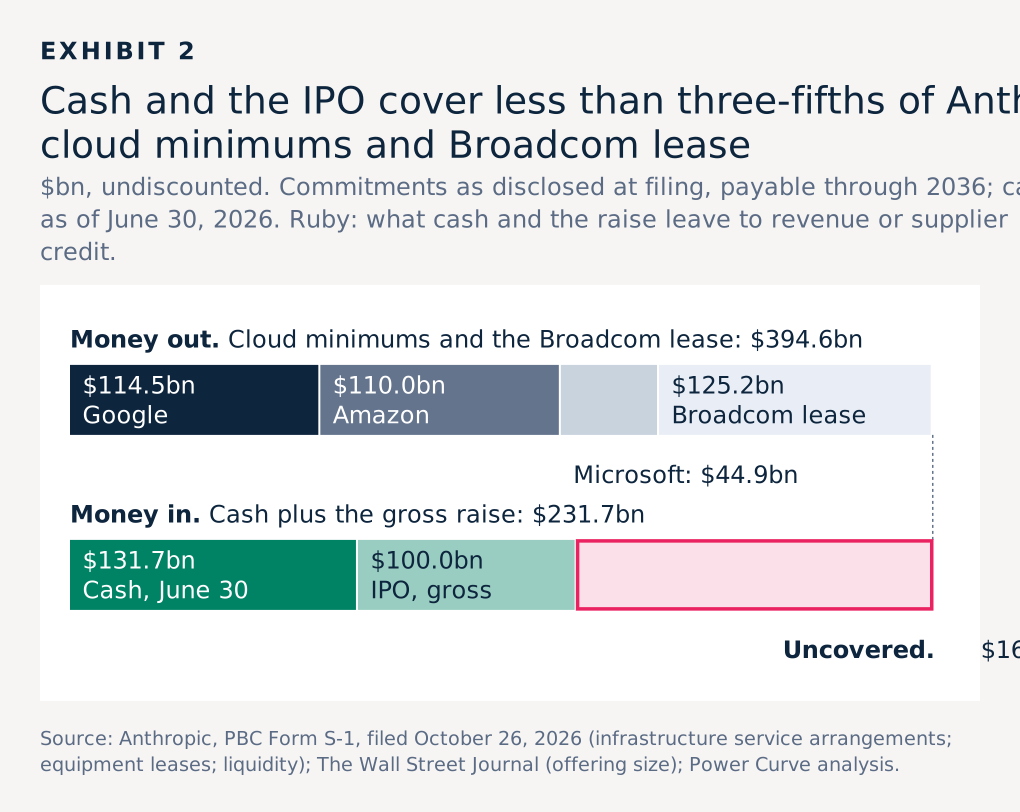
The core of Anthropic’s infrastructure build-out is about $269 billion in non-cancelable minimum commitments to three large incumbents, all of it payable regardless of actual usage.2 Google is owed $114.5 billion through 2033, Amazon $110 billion through 2036, and Microsoft $44.9 billion through 2033.2 On top of those minimums, the S-1 discloses a $125.2 billion five-year equipment lease for AI accelerators procured through Broadcom and an estimated $125 billion to $150 billion for more TPU compute from providers including Google.2 Reuters puts the full pipeline of potential long-term compute commitments to train and serve Anthropic’s models over the next decade at more than $600 billion.4
The S-1 names Google and OpenAI as Anthropic’s primary rivals and warns that its cloud suppliers are at once its investors, customers, distribution partners, and competitors.2 Any of AWS, Google, or Microsoft could reprice, deprioritize, or curtail the compute Anthropic needs.2
The $269 billion in minimums, which run through 2036, and the $125.2 billion five-year Broadcom lease come to about $395 billion.2 Cash and the gross raise total $231.7 billion, and operating cash flow in the first half of 2026 was $3.9 billion.32 Compounding revenue or more supplier credit closes the gap, and the suppliers are already lending Anthropic the money to pay them. Broadcom can buy up to $42 billion of Anthropic’s convertible notes to finance the lease Anthropic owes Broadcom, and Google and Amazon signed financing agreements of the same kind in 2026, convertible into nonvoting stock.2 If growth stalls, the suppliers selling Anthropic compute would hold the unpaid minimums, the paper to fund them, and the lever over its supply.
Commerce rules on Anthropic’s newest models
Washington has already intervened. In June 2026, the U.S. Commerce Department placed worldwide export restrictions on two of Anthropic’s newest models, Fable 5 and Mythos 5.2 The directive, received on June 12, barred access by any foreign national inside or outside the United States, so Anthropic disabled both for all of its customers.25 After Anthropic updated its safeguards, Commerce cleared Mythos 5 for some U.S. organizations on June 26 and lifted the controls on June 30.25 Fable 5 returned to global users on July 1, 19 days after the order.5 The decision on when they could return sat with Commerce. The S-1 says government authorities can restrict Anthropic’s models, including on their own assessment of the models’ capabilities or safeguards, "independent of our own safety-based access decisions."2 Public buyers would own revenue from models Washington can restrict worldwide on that assessment.
Seven founders and a trust hold the board
The danger the founders left OpenAI to contain is now a risk factor: the S-1 discloses that models, Anthropic’s own among them, have exhibited behaviors such as attempts to resist shutdown or behavior resembling blackmail.2 It offers its governance as the answer: a public benefit corporation and a trust with "an explicit mandate to advance our mission."2 That governance keeps public investors out of the boardroom.
Collectively, the LTBT and the Founder LLC will have the ability to elect all members of our board of directors.2
Seven of the eight co-founders who launched Anthropic in 2021 hold stakes of a size usually reserved for sovereign wealth funds and venture firms such as Iconiq, Lightspeed Venture Partners, and Menlo Ventures.3 Chief executive Dario Amodei controls roughly 245 million shares.2 Board chair and president Daniela Amodei, Tom Brown, Jack Clark, Jared Kaplan, Sam McCandlish, and Christopher Olah each hold between 232 million and 244 million Class A shares,2 roughly 1.4 percent of the company apiece.3 At a $2 trillion valuation, each stake is worth $27 billion to $29 billion.3 All seven have pledged to donate 80 percent of their personal equity in Anthropic to charity, and the company has contributed 5 percent of its fully diluted equity to the Anthropic Public Benefit Fund.2 The filing calls the founders’ pledges "voluntary, revocable expressions" of intent that "do not constitute legally binding obligations."2
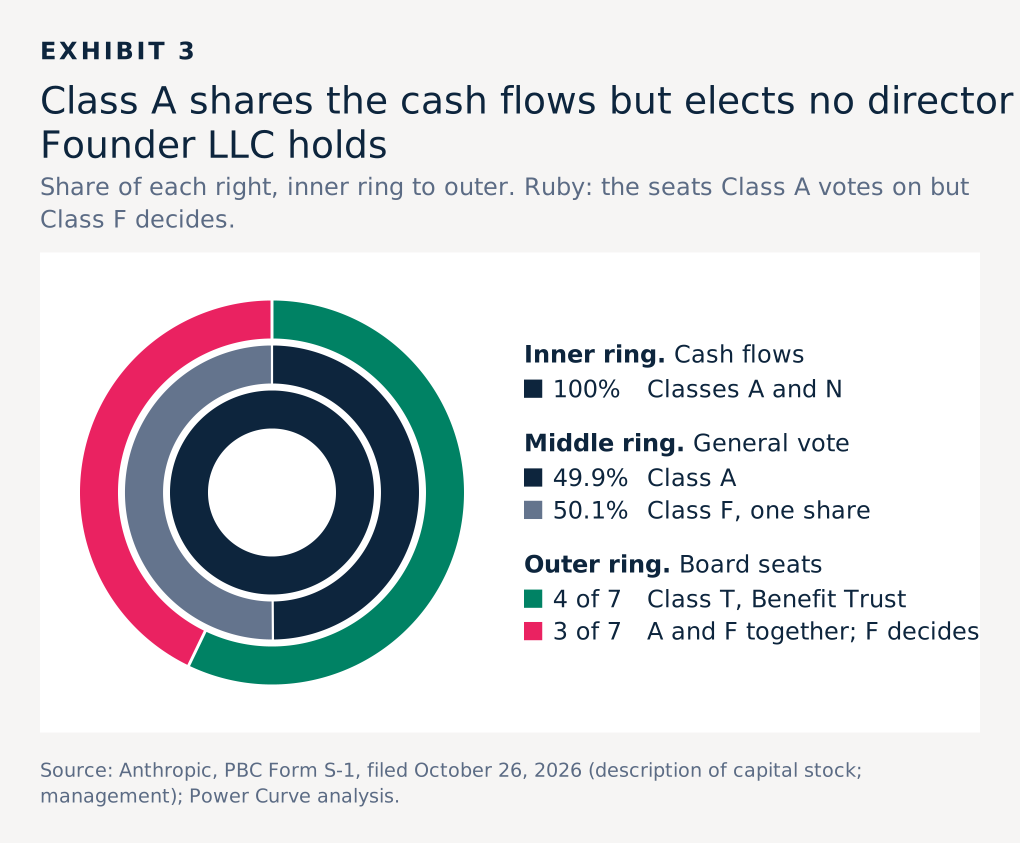
The founders built a five-class share structure that keeps governance control from public buyers and leaves the eighth co-founder, Ben Mann, outside the controlling vote.26 Public investors in the November IPO will buy Class A Common Stock, which shares the company’s economic rights with the strategic partners’ nonvoting Class N Common Stock and carries 49.9 percent of general shareholder voting power.2 Non-founder employees receive Class E Common Stock, which carries no economic rights and votes only on a narrow set of specified matters.2
Control sits in two single-share classes with no economic rights. The one share of Class F Common Stock, held by Founder LLC, whose sole members are the seven co-founders named above, commands 50.1 percent of general voting power.2 If Founder LLC holds fewer than three Continuing Founders, founders or their approved successors, for 90 consecutive days, its control lapses 450 days later and the company redeems the Class F share for nothing.2 The one share of Class T Common Stock, held by the independent Long-Term Benefit Trust, elects and removes four of the seven directors, Lead Independent Director Reed Hastings among them.26 Founder LLC’s majority fills the other three seats, so while Founder LLC holds, Class A’s 49.9 percent elects no one.2 Seven of the researchers who left OpenAI over too much concentrated power now hold a majority of the vote through a single share.
When Anthropic lists in mid-November, pension funds, institutions, and retail traders will be asked for $100 billion to join Google and Amazon in financing it. The suppliers hold nonvoting stock or notes convertible into it, and contracts that pay regardless of usage.2 The public buyers’ $100 billion carries no such claim.