

Since the end of World War 2, the "special relationship" has been more useful in London than in Washington, but the polling now confirms what diplomats have spent two decades not saying. American favorability toward Britain held above 75% for a generation. British favorability toward America has fallen from roughly 80% in 2000 to barely 30% by early 2026. The two lines were once close to parallel. They are now diverging at a rate that no postwar Anglo-American crisis, including Suez, ever produced. In the last twelve months, the American line has finally started to fall as well.
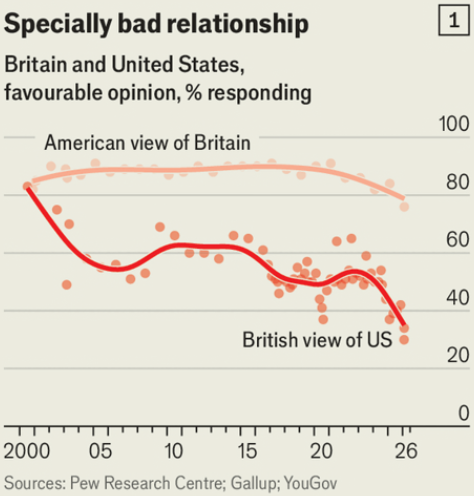
The conventional reading attributes the British collapse to specific events: Iraq, the financial crisis, Trump, Brexit, Gaza, tariffs. Each of these matters. None explains the shape of the curve. The decline is not episodic. It is a slow, durable repricing, punctuated by sharper drops in 2003, 2017, and 2024 but trending downward across administrations of both parties. That pattern points to something structural.
The deeper mechanism is asymmetry of consequence. For most of the postwar period, British and American voters experienced the alliance as a shared project with shared costs. Britain hosted American bases, joined American wars, and aligned its monetary policy and intelligence apparatus to American specifications. Both publics absorbed the same broad narrative: a liberal order, underwritten by American power, that produced rising prosperity for both. That bargain held while American power produced visible benefits for ordinary Britons.
It no longer does. Three shifts have compressed the bargain.
The Economic Shift
The 2008 financial crisis originated in American mortgage markets, was exported through the City of London, and produced two very different recoveries. UK working-age incomes grew 6% between 2007 and 2019. American incomes grew 12% over the same period. UK real average earnings flatlined for fifteen years, the longest stagnation since the Napoleonic Wars. By 2022, the median UK worker earned roughly $54,500 in purchasing-power terms against $78,000 for the median American worker, a 43% gap. The alliance now looks, from London, like a system in which American shocks become British recessions, and in which American recoveries do not become British recoveries.
The Strategic Shift
The Iraq war ended in failure, at considerable British cost. Its verdict came in the 2016 Chilcot Report, which concluded:
The judgements about the severity of the threat posed by Iraq's weapons of mass destruction were presented with a certainty that was not justified. Military action at that time was not a last resort. Mr. Blair overestimated his ability to influence US decisions on Iraq.
That last sentence is the one that mattered most for public opinion. It told the British voter, in the language of a state inquiry, that the price of alignment with Washington was Britain's ability to shape its own foreign policy. The lesson absorbed crossed party lines. Following Washington into a major commitment carries risks that fall disproportionately on the smaller partner, and produces influence that does not materialize.
The Political Shift
The Trump presidencies, in 2017 and again in 2025, broke the assumption that American foreign policy had a stable institutional core. Tariffs on British goods, public hostility to NATO, and the partial dismantling of the post-1945 trade architecture have made American policy itself a source of British economic risk. Between August 2024 and February 2025, British favorability toward the United States fell twelve percentage points in a single six-month window, from 49% to 37% in the YouGov EuroTrack series. The 2024 to 2026 period shows the steepest concentrated decline in the long Pew, Gallup, and YouGov composite. It coincides with a transatlantic tariff regime, an American withdrawal from Ukraine support, and the visible alignment of the White House with European parties Britain considers hostile to its interests.
The American Line Breaks
Until 2025, American opinion of Britain barely moved, because none of these shifts imposed costs on Americans. Britain remained a familiar, low-salience country in the American imagination. The alliance, viewed from Washington, was essentially free.
That has changed. Gallup's February 2026 World Affairs poll recorded American favorability toward Britain at 76%, an eight-point drop in a single year and the lowest figure Gallup has measured since it began asking the question. The decline was driven almost entirely by Republicans, whose favorability toward Britain fell twenty points, from 84% to 64%, establishing a new partisan low by a margin of eighteen points. Canada experienced an almost identical collapse on the American right.
This is the most important development. American opinion of Britain is now being shaped by American partisan politics rather than by Britain itself. A Labour government in London, historically friendly to the Democratic worldview, has become a reason for Republican voters to view Britain less favorably. The alliance has crossed a threshold it had not previously crossed. It is now polarized on both sides of the Atlantic.
Bottom Line
The chart records a British public that spent two decades quietly recalculating what American friendship was worth, arriving at a lower number every time, and an American public that has now begun to do the same. The relationship has been repriced on both sides of the ledger, and the structural drivers of that repricing have not exhausted themselves.
The consequence is institutional rather than rhetorical. The United States has historically relied on Britain as the most willing of its major allies, the partner that would commit forces, capital, and diplomatic cover faster than France or Germany would. That speed depended on a permissive British public, and the permission is gone. For London, diversification toward Europe, for trade, defense procurement, and security guarantees, has moved from hedging strategy to base case.
Three specific tripwires will determine whether the curves stabilize or continue diverging. First, whether Republican favorability toward Britain falls below 60% in the next Gallup wave, the threshold at which Britain becomes a partisan target rather than a neutral ally. Second, whether the Starmer government formalizes a UK to EU defense procurement framework outside of NATO channels, which would mark the operational beginning of strategic diversification. Third, whether American tariffs on UK financial services or pharmaceuticals, the two sectors where Britain has retained genuine competitive advantage, escalate beyond the current goods regime.
If two of the three break the wrong way within twelve months, the alliance will not collapse, but it will quietly become something other than special.