

Nvidia bet three decades ago on a kind of computing almost no one wanted. Artificial intelligence turned that bet into the scarcest infrastructure on earth.
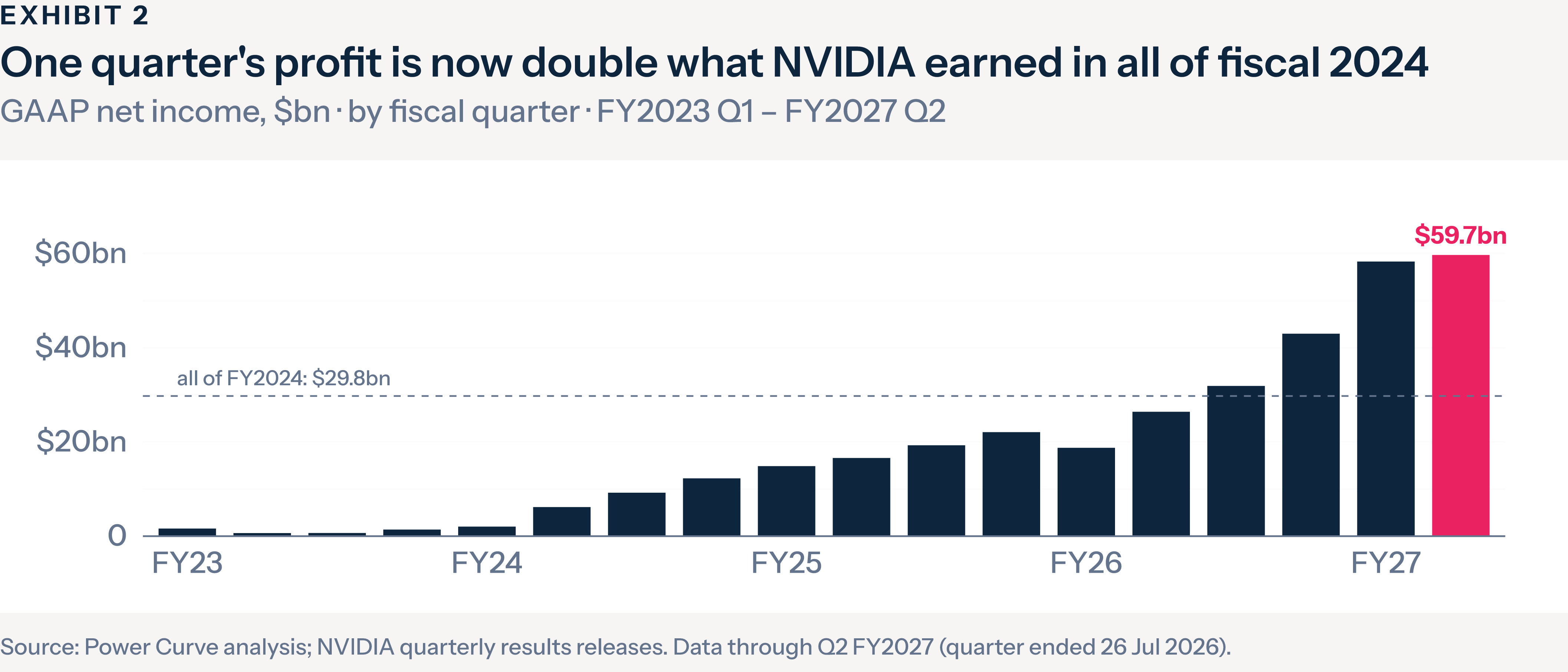
The results Nvidia reported on August 26 show what happens when one company owns a market that is exploding. Revenue reached $96.2 billion for the quarter. The company booked $63.7 billion in operating income and $59.7 billion in net profit, and maintained a gross margin of an extraordinary 75 percent.1 It guided to roughly $108 billion in revenue for the current quarter. It expects to earn all of that without selling a single data-center accelerator into China.1
The trajectory is steep. Nvidia earned $4.4 billion in all of fiscal 2023, $29.8 billion in fiscal 2024, $72.9 billion in fiscal 2025, and $120.1 billion in fiscal 2026.2 In the three months that ended in July, it earned roughly twice what it made in the entire year through January 2024.3
The acceleration looks sudden. It was not. Nvidia built this overnight success across three decades.
The Long Bet
Jensen Huang, Chris Malachowsky, and Curtis Priem founded Nvidia in 1993 to build chips for computer graphics. In 1999, the company shipped the first graphics processing unit, or GPU, and coined the term. Seven years later, it released CUDA, a software layer that let programmers aim the GPU at general-purpose computing.
That move mattered because of a difference in architecture. A central processing unit, or CPU, handles a few complex tasks in sequence. A GPU packs thousands of simpler cores that run enormous numbers of calculations at once. An engine built to render pixels turned out to suit scientific computing and machine learning almost perfectly, and CUDA made that engine programmable at scale.
From there the ecosystem compounded. Researchers built on CUDA. Universities trained engineers in it. Software libraries optimized around it. Nvidia widened the moat with networking, interconnects, and tighter hardware integration. By the time AI began demanding parallel computation at scale, Nvidia had spent more than a decade building a platform no rival could match.
Almost no one outside graphics noticed until 2012, when Alex Krizhevsky, Ilya Sutskever, and Geoffrey Hinton trained AlexNet on Nvidia GPUs and shattered the record in the ImageNet competition.4 That result pulled machine learning out of the research lab and into industry.
The False Ending
By 2022, Nvidia looked cornered. COVID-related gaming demand reversed. Cryptocurrency prices crashed, and when Ethereum abandoned proof-of-work mining, a whole class of GPU buyers vanished. Customers sat on excess inventory. Gaming revenue fell 27 percent in fiscal 2023, and net income fell 55 percent to $4.4 billion.5
The stock fell with the gaming business. The data center did not. Its revenue grew 41 percent that year,5 and Nvidia shipped the H100 into the exact moment a new generation of large language models began to prove what more compute could do.
Then ChatGPT launched at the end of 2022. Within weeks, it was clear that AI would anchor a new computing platform, generative AI, with infrastructure demands unlike anything the industry had priced.
When Compute Became Capital
After decades in a business the market treated as unglamorous, Nvidia reaped a lifetime of returns when computing became the most sought-after infrastructure in history.
Microsoft, Amazon, Alphabet, and Meta now commit hundreds of billions of dollars a year to building data centers around accelerated computing. The scale rivals the great buildouts of the past: the telecom, energy, and transport systems that took decades to lay down.
Nvidia sits at the center of that buildout, and its advantage runs deeper than raw chip speed. It increasingly sells an integrated system: GPUs, CPUs, high-speed networking, interconnects, software libraries, and rack-scale architecture. The unit of competition has moved from the chip to the entire AI data center.
That shift explains the margin. A 75 percent gross margin is almost unheard of for a hardware manufacturer. Nvidia sustains it because its advantages reinforce one another: leading performance, an embedded software ecosystem, a punishing product cadence, tight integration across compute and networking, and lower execution risk for customers deploying at enormous scale. Scarcity sharpens those advantages. It does not create them.
The result is economic rent: returns above the competitive level that persist because no rival offers the same bundle of performance, software compatibility, scale, and reliability. Nvidia's largest customers have every incentive to break that hold. They buy its hardware by the billion while funding custom silicon designed to escape it. That tension defines Nvidia's next chapter.
The Stock Follows the Rents
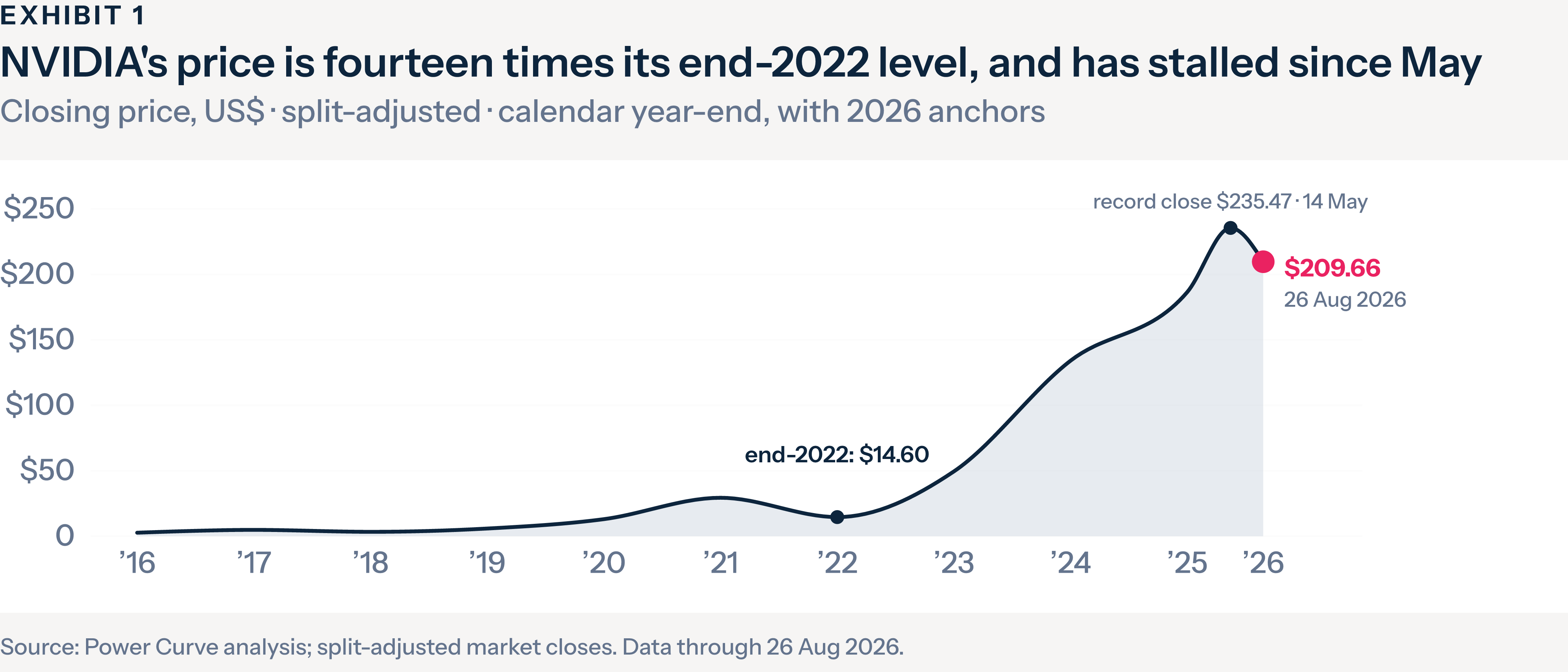
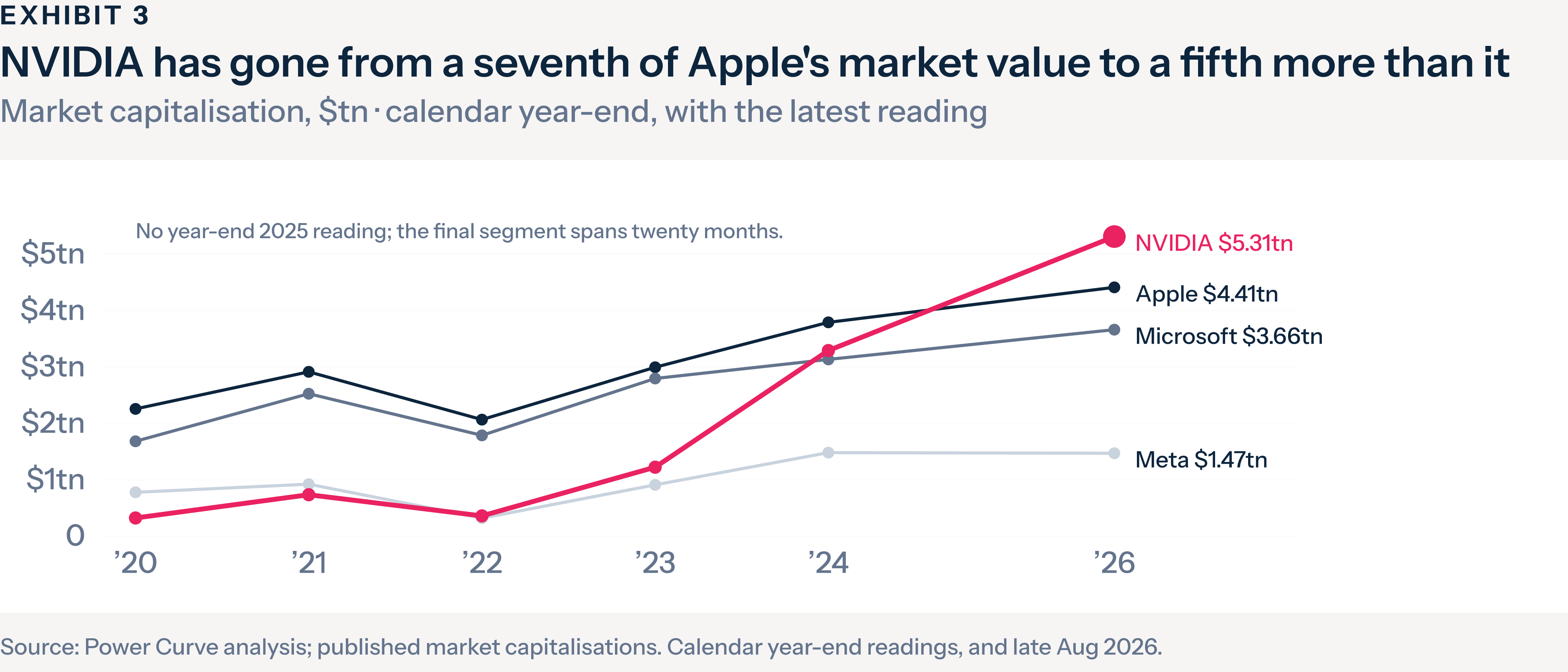
Nvidia's share price tracks the market's repricing of that position. By June 2024, the stock had climbed roughly elevenfold from its October 2022 low, and Nvidia briefly became the most valuable public company on earth. Its market value crossed $4 trillion in July 2025 and $5 trillion later that year.6
The August results pushed the repricing further. The quarterly guidance was strong. The more important signal came from the long view: management expects revenue to grow by about 70 percent in fiscal 2028, well ahead of Wall Street, with demand still outpacing supply.7
The valuation is hard to read because the denominator keeps moving. Profits have repeatedly outrun the multiples that looked stretched a few quarters earlier. A high price-to-earnings ratio tells you little when earnings compound this fast. Yet a $5 trillion company still has to deliver years of extraordinary results to justify the price.
The variables that matter are no longer next quarter's revenue or today's multiple. They are the duration of growth, the level at which margins settle, the capital required to maintain the technology lead, and the speed at which rivals erode Nvidia's pricing power. Small changes in those assumptions swing the valuation enormously. Nvidia does not merely need AI spending to stay high. It needs a large share of that spending to keep flowing through products on which it can continue to earn exceptional returns.
The Next Test
Three forces will decide whether it does.
The first is the return on AI itself. Nvidia sells into a capital cycle. Its customers spend because they expect AI infrastructure to pay off. The commitments are enormous; the payoff from many AI applications is still unproven. If the marginal return on the next data center starts to fall, spending growth slows, and Nvidia feels it early.
The second is substitution. Alphabet has TPUs. Amazon has Trainium. Microsoft and other hyperscalers are building their own silicon. AMD competes head-on. Model developers keep cutting the compute needed to reach a given level of performance. Nvidia can keep growing even as it cedes some share, provided the market expands fast enough. Holding its margins is the harder task, and it requires enough differentiation to keep customers from switching.
The third is geopolitics. Advanced AI processors are now strategic assets. U.S. export controls have repeatedly blocked Nvidia from selling its best chips into China. The current-quarter forecast assumes zero data-center compute revenue from China, which reflects both the strength of demand elsewhere and the political ceiling on the market.1 Other pressures are mounting: memory constraints are lifting costs, gross margins are set to ease, and Nvidia is committing more capital across the AI ecosystem, binding its fortunes tighter to the customers and projects that buy its chips.
None of this forecasts a reversal. It maps the channels through which Nvidia's economics could weaken.
The Price of Intelligence
Nvidia never had to predict generative AI. It had to be right about something more durable: that computing would keep shifting toward parallel processing as the old CPU gains grew harder to sustain. CUDA turned that insight into an ecosystem. Machine learning proved its worth. Generative AI expanded the market to the point where the value of Nvidia's position became impossible to ignore.
That sequence is the lesson. Technological advantage usually accumulates before the market understands its worth. Nvidia's profitability rests on years of compounding investment in hardware, software, networking, developer loyalty, and engineering depth. Each reinforced the others. So far, the earnings have justified most of the repricing. The company is generating revenue and profit at a scale that seemed implausible three years ago, with margins the market reserves for software.
So the question has changed. When Nvidia was worth a few hundred billion dollars, investors had to decide whether AI would become a large enough market. That question is settled. At more than $5 trillion, the harder question is whether Nvidia can defend enough of its advantage, ecosystem, supply execution, and pricing power to keep capturing a disproportionate share of the value AI creates.
Nvidia rose because it was ready when compute became scarce and strategic. Its valuation now rests on one thing: how long it can keep its platform different enough to keep the rents.