

Lockheed Martin has deployed roughly $500 million of venture capital since 2007. Against a company that booked $75 billion of revenue last year and spends about $1.6 billion annually on its own research, that sum is a rounding error. More than sixty of its portfolio companies have nonetheless become Lockheed suppliers, and those companies have received in excess of $750 million in Lockheed contracts.1 2 The capital is trivial. The claim it establishes is durable and invisible to every mechanism built to review industrial concentration.
This is the development the current commentary misses. Defense primes are widely described as trying to behave more like Silicon Valley, an interpretation that treats venture investment as a cultural project inside an industrial company. The activity is better understood as a procurement instrument operating ahead of procurement. A minority stake buys information, access, and a position in a sequence: discover a technology, validate it under military conditions, integrate it into a platform, and take control when its importance becomes clear. Commitment rises at each step as uncertainty falls. The prime contractor is becoming a portfolio manager for military technology, and it is acquiring that role at a price low enough that no regulator has reason to look closely.
The question worth asking is whether a capital-allocation system this cheap to operate will produce a more capable industrial base, or a more innovative version of the concentration that already exists.
KEY JUDGMENT
Prime venture investment is too small to reshape the defense industrial base through capital and large enough to reshape it through sequencing. The binding variable is the rate at which portfolio companies convert into dependent suppliers. On the only disclosed record, that rate is approximately one in two.
The price of an option
Traditional defense research concentrated development inside large contractors, government laboratories, and formally funded acquisition programs. That arrangement followed from the economics of major weapons systems, which required secure facilities, specialized engineering, extensive testing, and procurement cycles measured in decades. Few organizations could enter the market and fewer could reach production.
Many technologies now shaping military advantage develop under different conditions. Artificial-intelligence systems improve through commercial computing markets. Autonomous vehicles can be redesigned within months. Satellite manufacturers spread development costs across military and civilian customers. Software products remain in continuous development rather than reaching a fixed configuration.
A prime attempting to internalize every relevant capability would face an allocation problem it cannot solve. It would need to predict which technologies would matter, which technical approaches would succeed, and which teams could execute, then sustain expertise across fields changing faster than the platforms into which they might eventually be incorporated. Internal research remains appropriate for capabilities requiring deep integration, secrecy, or long horizons. It scales poorly against uncertainty.
Minority investment resolves this cheaply. A small stake purchases technical information, management relationships, and a claim on future commercial access without requiring conviction about outcomes. The prime buys the right to decide later, at a price set before the answer is known. Lockheed's average position across its portfolio is roughly $4 million per company, which is the cost of a modest engineering study and considerably less than the cost of being wrong about autonomy or advanced manufacturing.
RTX operates the same model across autonomy, sensing, computing, advanced manufacturing, and space, and has connected venture-backed manufacturing firms to production constraints inside its own businesses.3 Its agreement with Shield AI, which places Shield AI autonomy into selected RTX products including loitering munitions and sensor systems, shows the model extending past finance into product architecture.4 Boeing has pursued the same exposure through an intermediary, anchoring a second AE Industrial Partners fund with $50 million and leaving management to a specialized investor.5 BAE Systems has committed €50 million to two European defense venture funds, and Airbus has become anchor investor in a €500 million dual-use vehicle.6
Discover, validate, integrate, control
The model reduces to four stages, and the order carries the significance.
Discovery runs through accelerators, venture funds, technical networks, and minority positions. Validation follows through supplier awards, pilot projects, and joint-development agreements that establish whether a capability survives security requirements, production standards, cost targets, and program schedules. Integration embeds the technology in a platform, proposal, or production system, at which point switching costs rise on both sides. Control arrives last, through acquisition, when the capability, workforce, intellectual property, or productive capacity has become sufficiently important to own outright. Lockheed's 2024 purchase of Terran Orbital followed years in which the satellite manufacturer had served as supplier, partner, and investment.7
The prime purchases information first, capability second, and ownership last.
The funnel narrows sharply, and it narrows twice.
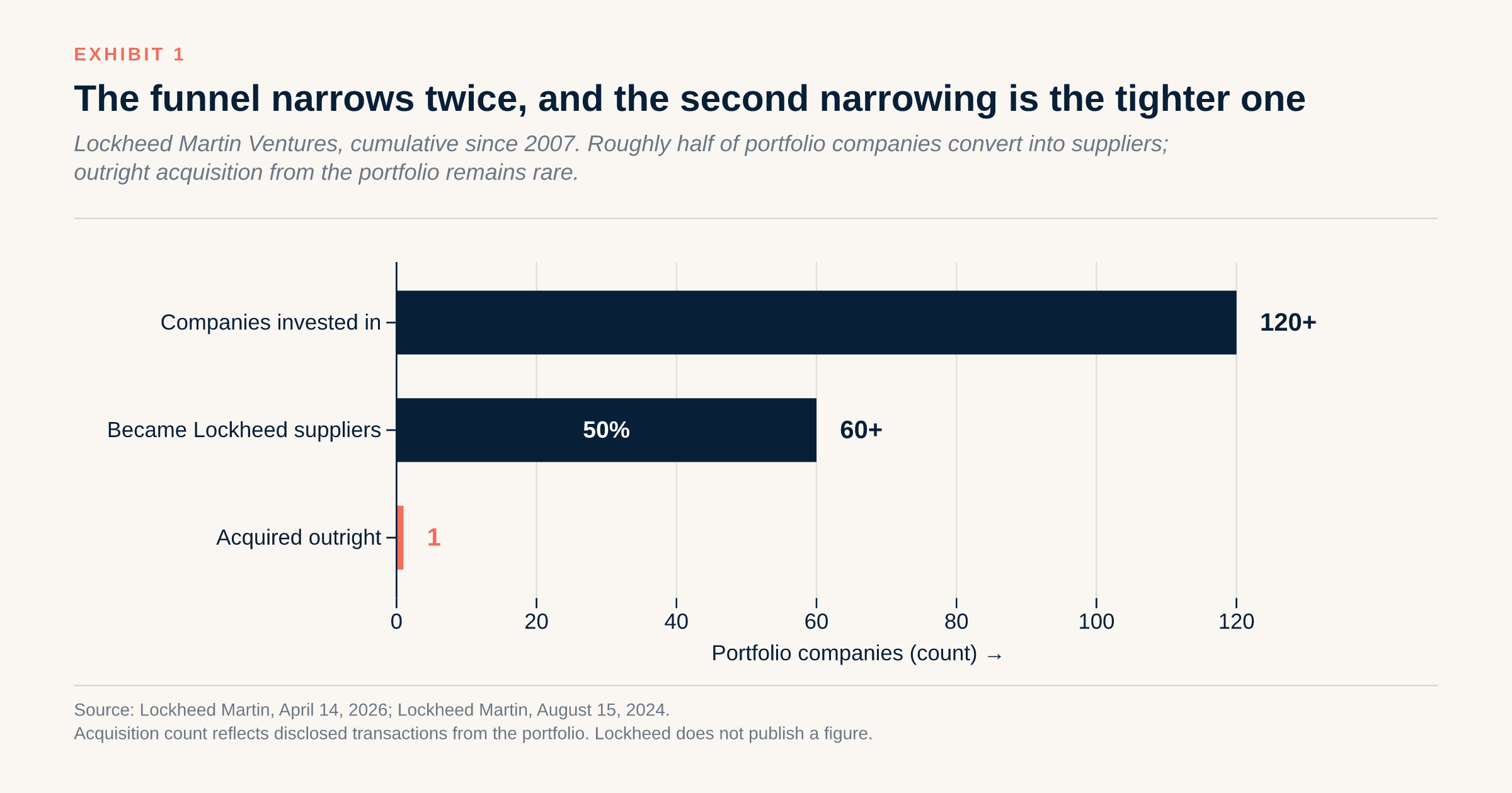
The first narrowing is the important one. Approximately one in two portfolio companies becomes a supplier, a conversion rate no financial investor could approach because no financial investor controls the demand. The second narrowing is far tighter. Acquisition from the portfolio is rare, which means the dominant mechanism of influence is contractual dependency rather than ownership. That distinction matters for anyone assessing competitive risk, because merger review examines the second mechanism and has nothing to say about the first.
Why the sum misleads
Reported figures overstate what primes are spending and understate what they are buying.
Defense contractors participated in a record $4.1 billion of venture rounds during the first seven months of 2026, according to Dealroom data reported by the Financial Times.8 That figure measures the total value of rounds in which a prime took part. The primes' own contribution is a fraction of it, and the underlying market definitions include dual-use and adjacent technologies, so the headline should not be read as capital flowing into weapons.
Set against a single prime's own accounts, the scale becomes clear.
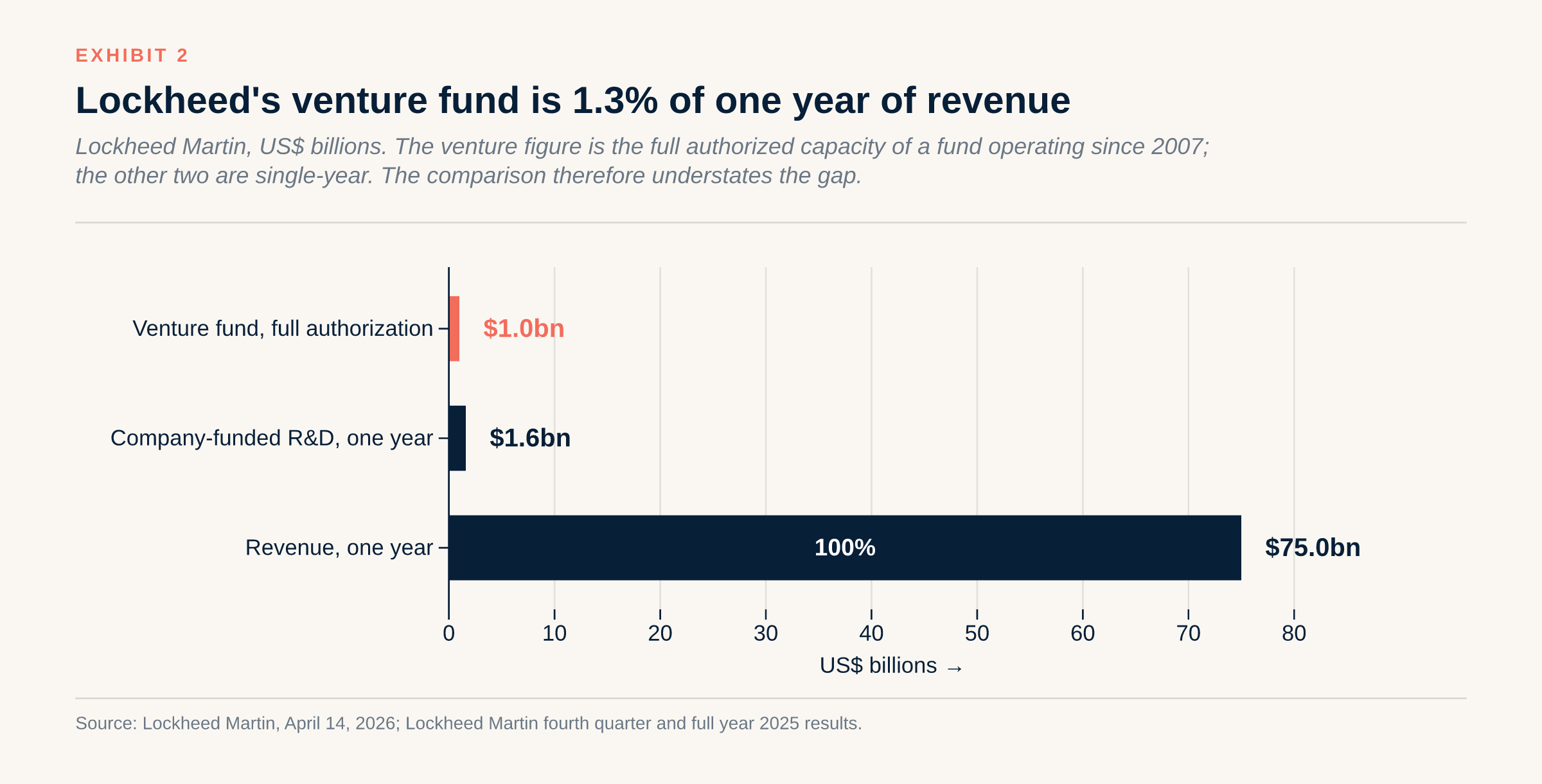
Lockheed's expanded venture authorization of up to $1 billion represents about 1.3 percent of one year's revenue and roughly two thirds of one year's company-funded research.1 2 Deployed capital has averaged something near $26 million a year since 2007, or under two percent of annual internal research spending. On any balance-sheet measure, prime venture activity is immaterial.
This is precisely why it deserves attention. An instrument that consumes almost no capital faces almost no internal scrutiny, generates no disclosure obligation, and triggers no regulatory threshold, while establishing positions that determine which suppliers exist five years later. Cheapness is the mechanism.
The conversion advantage
Financial investors supply capital, networks, and advice. Primes supply something no venture firm can replicate, which is the ability to convert a prototype into a fielded military capability.
That distance is substantial. Technologies must pass security reviews, satisfy technical standards, survive testing, integrate with existing platforms, fit government contracting rules, reach production quality, and remain supportable across years of operation. The institutional knowledge required is difficult to reproduce quickly. Primes understand how requirements are interpreted, how interfaces are controlled, how systems are certified, how costs are documented, and how programs survive budgetary and political cycles.
Their role is translational. Startups understand emerging technology, military users understand operational problems, and primes understand integration, production, sustainment, and acquisition. A well-managed portfolio connects the three, and it gives the corporate investor an information set the financial investor cannot assemble: a manufacturing company can be assessed against a known production bottleneck, an autonomy stack against the specific sensors and munitions it might control.
The evidence that this conversion machinery works is weaker than the theory. Lockheed's disclosed $750 million in contracts spread across more than sixty suppliers averages roughly $12.5 million per company, cumulative over nearly two decades. That is a sourcing relationship. Many corporate venture programs fail at exactly this point: they accumulate positions but cannot persuade business units to adopt them, because procurement treats startups as risky suppliers, program managers protect schedules, and security and legal review consume time no small company has. Exposure to innovation does not guarantee absorption.
The enclosure risk
The structure that helps startups scale also constrains their independence. A company that accepts strategic investment gains credibility and customer access, then finds its product roadmap aligning with one prime's platforms and its revenue concentrating in one industrial relationship. It becomes more valuable as a supplier while losing the standing to challenge the market's shape. Acquisition creates the related risk in sharper form, supplying capital, facilities, and government access while dissolving the concentrated authority and rapid iteration that made the company effective.
The competitive risk is cumulative rather than transactional. Each investment may be rational alone; a succession of them narrows the number of independent firms able to compete for system-level work. The Government Accountability Office has found that defense mergers can improve supplier financial health while also reducing competition, raising costs, and weakening innovation, and has concluded that the Department of Defense lacks sufficient information to evaluate some post-transaction effects.9
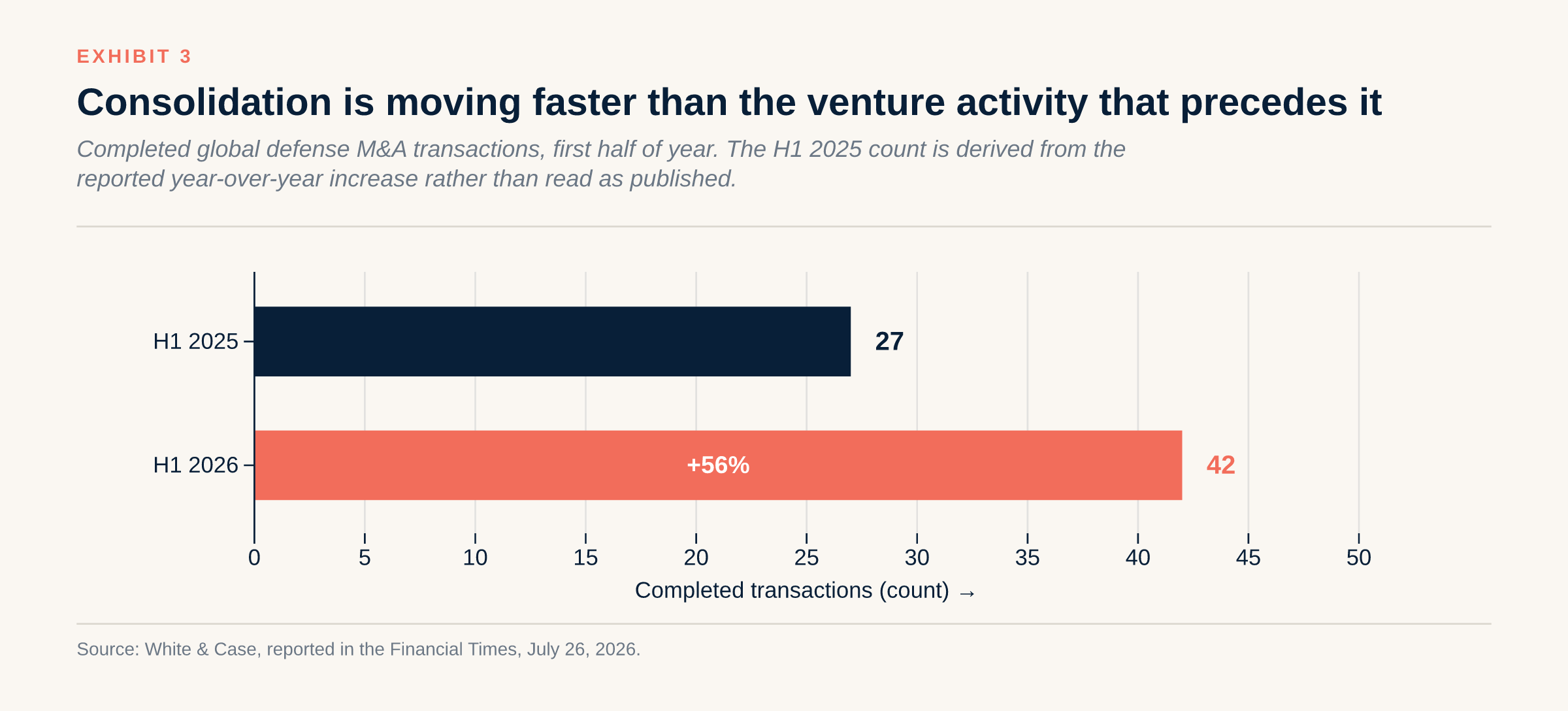
Consolidation is moving faster than the venture activity that precedes it.
One case cuts against the thesis and deserves to be stated plainly. Anduril raised $5 billion at a $61 billion valuation in 2026 and has pursued system-level contracts rather than component supply, and it did so without passing through the prime funnel.10 Its independence establishes that the enclosure risk is conditional: a company with sufficient private capital and sufficient appetite for direct competition can bypass the incumbents entirely. That path exists. It is also available to perhaps a handful of firms in any cycle, and the remaining several hundred face a choice between prime capital and no capital at all. The exception clarifies the rule instead of overturning it.
Preserving paths to scale
Government has its own capital-allocation instruments and should use them as a counterweight rather than delegating the function.
The Defense Innovation Unit and the Office of Strategic Capital already place government capital and credit directly with nontraditional suppliers, which prevents primes from becoming the sole gateway to military demand. SBIR Phase III authority permits sole-source follow-on awards without further competition, and it is systematically underused as a scaling mechanism. Other Transaction Authority and the Middle Tier of Acquisition pathway allow prototyping and production outside the standard cycle, which is where a venture-backed firm can most plausibly demonstrate that it can perform as a prime. Defense Production Act Title III funding can relieve the same production bottlenecks that prime venture units are currently financing privately, and at larger scale.
Architecture matters as much as capital. The modular open systems approach Congress already requires for major acquisition programs permits components to be replaced without redesigning the system, and its enforcement determines whether integration creates a genuine switching cost or merely a preference. Data rights should be structured so that one integrator cannot control future upgrades to a capability the government paid to develop. Competitive prototyping should preserve at least two technical approaches through the point where performance can be compared rather than asserted.
Acquisition review should also consider potential competition. A startup may not sell the same product as a prime at the moment of purchase and still hold the technology and workforce required to become a future system provider. The treatment should differ by type. A materials firm or specialized component manufacturer genuinely depends on a prime for integration and scale, and its acquisition may create value that independence would not. An autonomous aircraft, software platform, satellite network, or maritime system can form the foundation of an independent competitor, and its acquisition forecloses one.
Prime contractors' capacity to integrate, certify, manufacture, and sustain complex systems remains indispensable, and none of this argues for weakening it. The objective is to ensure their investment activity strengthens the wider industrial base instead of making it dependent on a small group of corporate gatekeepers.
What to watch
Three measures would confirm or weaken this judgment within twelve to eighteen months.
The first is the conversion rate. Lockheed's roughly one-in-two ratio of portfolio companies to suppliers is currently the only disclosed figure of its kind. If comparable disclosure from RTX, Boeing, or BAE shows materially lower conversion, prime venture activity is closer to scouting than to industrial strategy and the enclosure concern recedes.
The second is average contract value per portfolio supplier. Lockheed's cumulative figure of roughly $12.5 million per company is subscale relative to program economics. A rise toward $50 million or above would indicate that portfolio companies are entering programs of record rather than supplying at the margin, which is the point at which dependency becomes binding.
The third is whether any venture-backed entrant wins a system-level prime contract without prime equity on its capitalization table. Anduril is the live test. A second and third instance would establish that an independent path to scale persists; their absence over the next two budget cycles would suggest the funnel has become the only route.
Prime contractors will continue to be judged by the aircraft, missiles, satellites, sensors, and ships they deliver, and those outputs will increasingly depend on allocation decisions made years before a program exists. The firms that allocate well will shape which technologies reach the field, which suppliers survive, and which competitors emerge. Their venture activity is becoming part of the machinery through which private capital is converted into military capability.
The sums involved will never look large enough to warrant attention, and that is the reason to pay it. The arsenal is becoming a portfolio at a cost no one has to justify.