

A war premium in energy and a capital boom in artificial intelligence are splitting the world economy into two circuits that one interest rate cannot govern.
One circuit runs on energy, and on the war premium now lodged in the price of oil. The other circuit runs on the capital flooding into artificial intelligence, and on the handful of economies underpinning its value chain. Headline growth of 3.0 percent in 2026 is the average of the two, but the average fails to capture on-the-ground realities 1. The consequential problem is monetary. A single policy rate has to answer to a stagflationary energy shock in one circuit and an investment boom in the other. The setting that steadies one destabilizes the other.
Two circuits
The first circuit runs on physical commodities. Its defining feature in 2026 is a war premium: an energy shock that raises prices and lowers output simultaneously. A central bank facing it holds rates high to contain imported inflation, paying for it with weaker demand.
The second circuit runs on compute. Its defining feature is the roughly 725 billion dollars the five largest technology firms will spend this year building artificial-intelligence infrastructure, capital that bids up power, chips, and specialized labor and concentrates growth in the economies driving that supply chain 2. A central bank facing this circuit also holds rates high, through a different mechanism: to keep an investment boom from inflating asset prices before the promised productivity gains arrive.
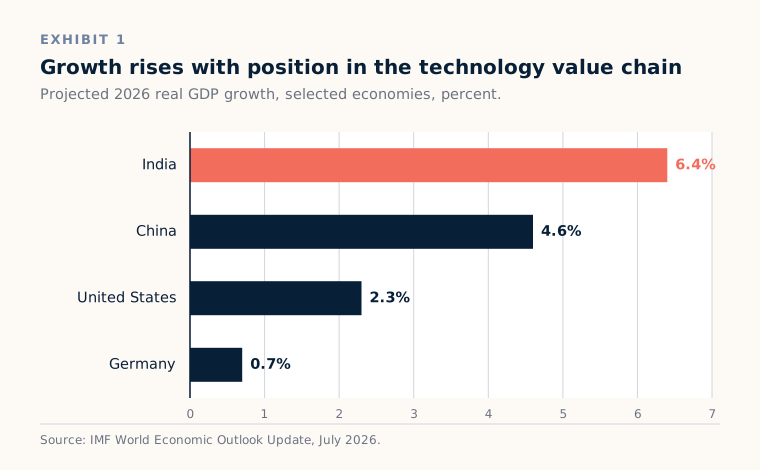
Most economies contain both circuits in different proportions, and the mix sets the outcome. The United States runs a large compute circuit and moderate energy exposure, which keeps growth near 2.3 percent while inflation stays sticky. Germany runs heavy energy exposure and a thin compute circuit, resulting in anemic 0.7 percent growth 1.
What the 1973 precedent teaches, and where it stops
The oil embargo of 1973 produced the original stagflation, ending the postwar assumption that inflation and unemployment could not climb together. The 2026 energy shock is larger in its initial supply hit, by the World Bank's reckoning the largest disruption to oil supply on record 3. The economy of 1973 had no offsetting boom. The economy of 2026 carries a technology investment surge large enough to serve, on its own, as the primary driver of US growth 4. The lesson central banks drew in the 1970s was to fear a wage-price spiral. The task now is to manage a two-speed economy in which one policy rate runs too loose for the compute circuit and too tight for the energy circuit.
The energy circuit
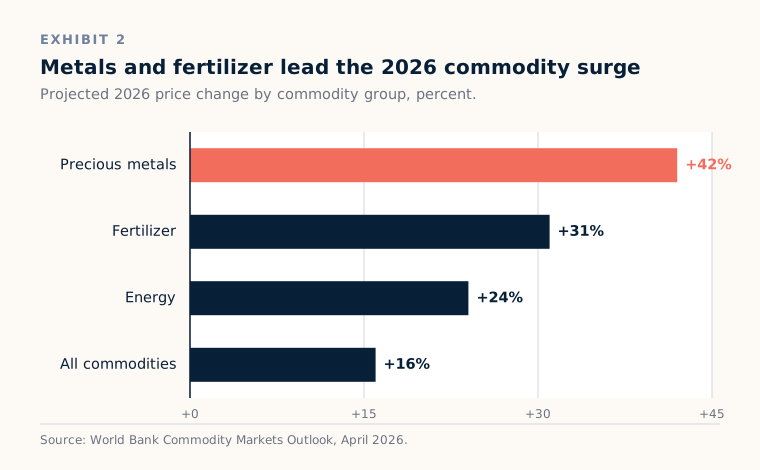
The energy circuit is stagflationary by construction. The World Bank projects energy prices to rise 24 percent in 2026, to their highest level since Russia invaded Ukraine, and commodity prices to rise 16 percent overall 3. The driver is physical supply. Disruption around the Strait of Hormuz, which carries roughly 35 percent of seaborne crude, produced an initial supply loss on the order of 10 million barrels a day, and Brent traded more than 50 percent above its start-of-year level at the April peak 3. The shock propagates through the commodity markets: fertilizer prices are set to rise 31 percent as gas-linked input costs climb, and precious metals, which investors accumulate for protection, are set to rise 42 percent 3. For an energy importer the result is an inflation tax and a growth drag arriving together, which stalls disinflation and falls hardest on the economies least able to absorb it 1.
The compute circuit
The compute circuit runs on capital expenditure at a scale without precedent. JPMorgan puts cumulative AI-related capital spending at 5.5 trillion dollars through 2030, and the 2026 outlay of the five largest technology firms alone exceeds the annual output of Switzerland 2. That spending lifts the economies most deeply embedded in the technology value chain and leaves the rest to absorb the energy shock unaided 1. The IMF's own figures trace the split: India, deep in services and the technology supply chain, grows 6.4 percent; China, weighed by higher oil prices and structural drag, 4.6 percent; and Germany, exposed to energy and light on compute, 0.7 percent 1.
Where they collide
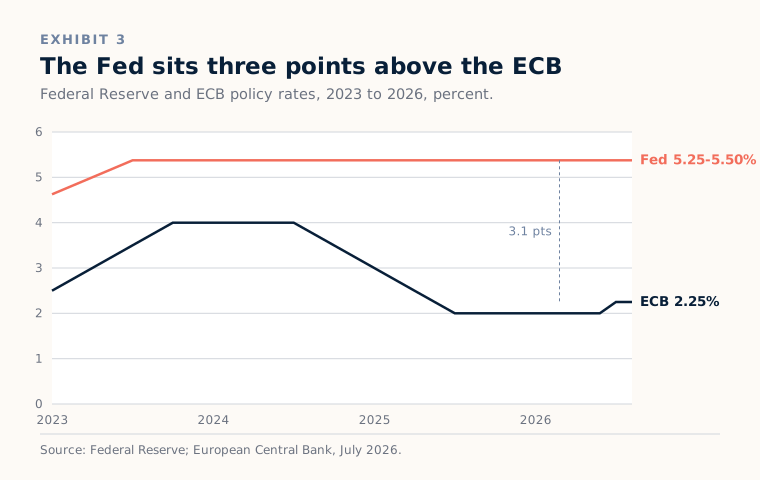
The collision is monetary. The Federal Reserve has held its target at 5.25 to 5.50 percent longer than almost any forecaster expected, because US inflation remains sticky in services, shelter, and wages 1. The European Central Bank has eased from a 4.0 percent peak to 2.25 percent as euro-area demand weakened, raising rates only slightly in June as inflation proved stubborn 5. The two anchor central banks now sit more than three percentage points apart, the widest gap of the cycle, and that spread is the largest single force in the dollar-euro exchange rate 5. When the price of money diverges this far between the two largest reserve currencies, the divergence becomes a global transmission channel: capital flows toward the higher-yielding dollar, financial conditions tighten in the euro area, and the American inflation problem is exported worldwide.
What it means for your book
The near-term situation rewards real assets and energy exposure over duration, favoring the dollar while the rate gap holds. The larger exposure is correlation. A downward repricing of AI profitability and a fresh commodity spike from the war in Iran could arrive together and tighten financial conditions from both circuits at once. The IMF names these two as its principal downside risks, an unusual pairing of a boom and a shock as symmetric threats 1. Markets are already testing the compute circuit: three of the four largest firms investing in AI lost value after their most recent earnings, as investors weighed capital commitments against realized returns 2.
For firms, exposure is now both geographic and sectoral. A manufacturer in an energy-importing economy carries the war premium without the compute offset. A firm inside the AI supply chain carries abundant demand alongside rising power and capital costs and the tail risk that the capex cycle runs ahead of returns. For policymakers, the trap is structural: a rate high enough to contain imported inflation starves the energy circuit of relief, and a rate low enough to cushion it feeds the capital surge and the asset prices riding on it.
What to watch
Three variables would confirm, weaken, or reverse this reading. The first is the Strait of Hormuz: a durable de-escalation that returns Brent toward its start-of-year level removes the war premium and narrows the divergence. The second is big tech guidance over the next two quarters: a broad capex cut would remove the boom and expose how much of US growth rested on it. The third is the Fed-ECB spread: a Fed move to easing would signal that the American inflation problem has broken.
The world economy is running two circuits at different speeds, and the monetary tool that once governed both now handles neither fully. Treat the next two quarters as a divergence scenario. Position for real assets and dollar strength, stress-test for the correlated shock in which an AI repricing and an energy spike land together, and read the aggregate growth number as the average of two economic systems that no longer move in unison.