The Economist/YouGov poll marking America's 250th anniversary contains a finding that should unsettle anyone who treats public sentiment as a reliable gauge of the state of the Union: by nearly every quantifiable measure, life in the United States has improved, yet 66 percent of respondents believe the country's best days are behind it, and 63 percent say the nation is on the wrong track. The disconnect is troubling in many ways.
Objective human progress and subjective national confidence have decoupled, and the mechanism driving that decoupling—status anxiety, comparison inflation, and the erosion of shared narrative—is longer-lasting than an election cycle or more durable than most economic indicators. The practical implication is that policymakers, civic organizations, and, yes, data disciples who treat rising GDP or falling mortality as self-evidently persuasive are fighting the wrong battle.
The contest here is over meaning, not data tables or trendlines.
The Underlying Mechanism
Call it the legibility gap: the widening distance between what a society has achieved and what its members believe it has achieved. The poll's underlying data is clear. Americans live longer and earn more in real terms than at any prior point in the nation's history. Yet only a minority describe themselves as very proud to be American, and a supermajority believes the Republic has drifted from its founding principles. The conventional explanation that bad news travels faster than good news is true but insufficient, leaving open the question why pessimism has hardened into a near-consensus position that crosses party lines even as the two parties disagree about almost everything else.
The more useful explanation treats confidence as a relative good, not an absolute one. People do not evaluate their circumstances against a historical baseline of infant mortality rates or per capita income from 1926. They evaluate their circumstances against an imagined past, against their neighbors, and against the promises they believe were made to them. When the gap between expectation and experience widens, measured prosperity becomes politically and psychologically irrelevant. This sentiment underpins the poll's headline numbers. It explains why the most materially secure cohort in the survey, older Republicans, report the greatest pride alongside the sharpest sense of national decline.
The Curse of Nostalgia
The poll's most revealing data point is the shape of the pessimism. Thirty-nine percent of respondents named 1981 to 2000 as the high point of the past century, a finding the article's own reporting attributes less to objective conditions in those decades than to the fact that respondents "came of age" during them. This is a tell. The selection of a golden era reflects personal biography rather than measurable outcomes, so the underlying sentiment is deeply rooted in the respondents' lived experience. It is about the loss of a particular kind of certainty: the feeling of a hopeful, legible future. Lifespan and income are abstractions. Hope and legibility are not.
This insight redefines the policy problem. A government cannot restore 1995 to someone who associates it with adolescence rather than with interest rates or productivity growth. What it can address is the structural source of present-day cynicism, though, including the sense among large shares of respondents that institutions no longer operate by stated rules, that upward mobility has stalled, and that the rewards of growth have become difficult to trace back to one's own effort.
The poll's finding that economic inequality ranks as a top failure among Black and Hispanic respondents, while political polarization dominates for white respondents, suggests the illegibility is not uniform. Different groups are losing confidence in different mechanisms, even as the aggregate pessimism looks identical from a distance.
Partisanship Has Replaced Macroeconomics as the Variable That Moves Sentiment
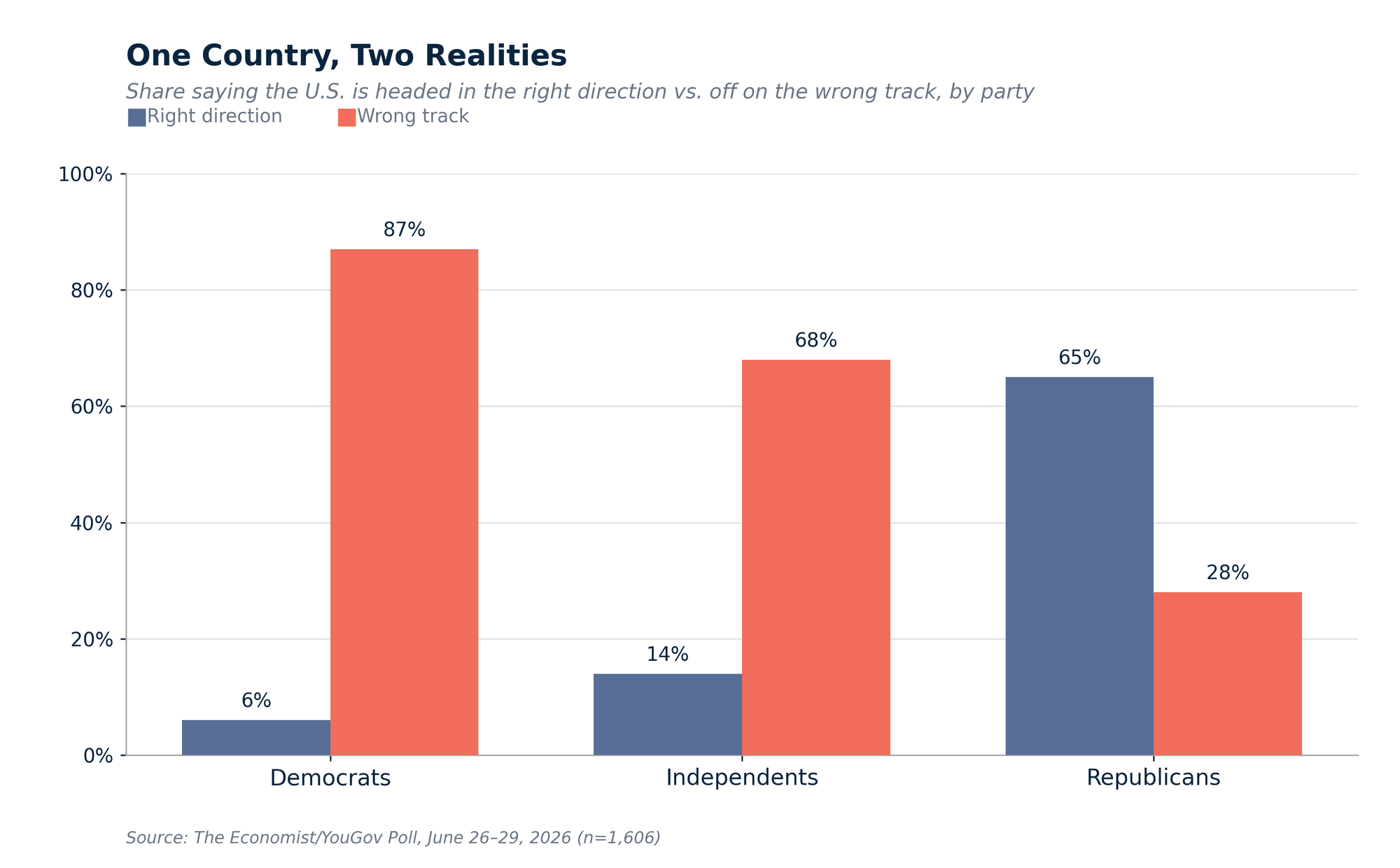
The clearest evidence for the structural character of this gap is its responsiveness to political control rather than economic data. In the current poll, 91 percent of Democrats describe the country as on the wrong track, against 25 percent of Republicans, a spread of 66 points. YouGov's tracking since 2009 shows this pattern is not new, but the magnitude is greater than previous polls. Sentiment moves with elections, not with GDP releases, the business cycle, or life-expectancy tables. This disconnect is the clearest possible evidence that the poll is measuring an expression of identity and access to power, not an assessment of conditions.
This finding has a direct implication for how public institutions and private organizations should interpret confidence data in the future. Indices built on the assumption that respondents are reporting an economic judgment will systematically underreport a population that is, in practice, reporting a tribal one. Nevertheless, the arithmetic underneath the rhetoric–longevity, income, technological capability–remains sound. The willingness of either party's base to credit the other party's stewardship for any of it has weakened instead.
Confidence Has Compressed
The poll complicates the simple pessimism narrative in one important respect: more than two-thirds of respondents expect the country to grow stronger or hold steady over the next fifty years, and respondents aged 18 to 29 are the most optimistic cohort in the survey. Long-horizon belief in America's future, the enterprising spirit that backstops entrepreneurship, investment, and institution-building, remains largely intact. Under this gap, confidence compresses but does not vanish. Only 17 percent of respondents are almost certain the country will reach its 500th anniversary intact, evidence that existential confidence continues to erode even as near-term and medium-term confidence hold.
This pattern points to a leadership crisis. Respondents appear to trust the nation's underlying productive capacity more than they trust the institutions tasked with carrying that capacity forward. Most people reading understand the sentiment. But that is a narrower and more addressable problem than a wholesale loss of faith in American material life, pointing to where confidence-building efforts would have the highest return: not in advertising present abundance, which respondents already perceive and have priced out, but in demonstrating institutional durability across the kind of multi-decade horizon that 17 percent currently doubt. No easy task.
Implications
For policymakers, performance metrics alone–X jobs, or Y dollars–will not rebuild confidence. Arguments about rising life expectancy or falling poverty rates will continue to underperform unless paired with a credible account of how institutions can sustain those gains over a horizon longer than the next election.
For businesses and investors, the partisan volatility in sentiment data is a signal to strongly discount survey-based confidence measures when they diverge sharply from hard data. Instead, leaders should weight underlying productive capacity, which the poll suggests Americans still broadly trust, more heavily than headline pessimism in long-duration capital decisions.
For institutions seeking to rebuild legitimacy, the relevant audiences are the narrow cohorts whose confidence has decoupled from material reality, not the electorate as a whole.
What to Watch
The 500th-anniversary confidence figure, currently 17 percent, may be the most diagnostic number in the survey. A meaningful rise would indicate the gap is narrowing on the dimension that matters most, institutional durability, rather than merely fluctuating with electoral control. A continued decline alongside stable economic data would confirm that the gap between material conditions and national confidence has become self-sustaining rather than episodic or cyclical.
The size of the partisan swing in "wrong track" sentiment after the next change in White House control will indicate whether confidence is becoming more or less tethered to identity relative to outcomes. A narrowing swing would suggest the gap is moderating. A widening one would suggest it is hardening into a permanent feature of American political psychology.
The United States is a remarkable nation for many reasons. Unfortunately, progress in America is not currently legible, durable, and shared in the eyes of those living through it. Closing this gap will require less emphasis on proving that conditions have improved, a case the data already wins, and more emphasis on rebuilding the institutional credibility that would make Americans willing to believe the gains will sustain for them and their children. The arithmetic of prosperity is settled. The arithmetic of trust remains elusive.
Additional Findings
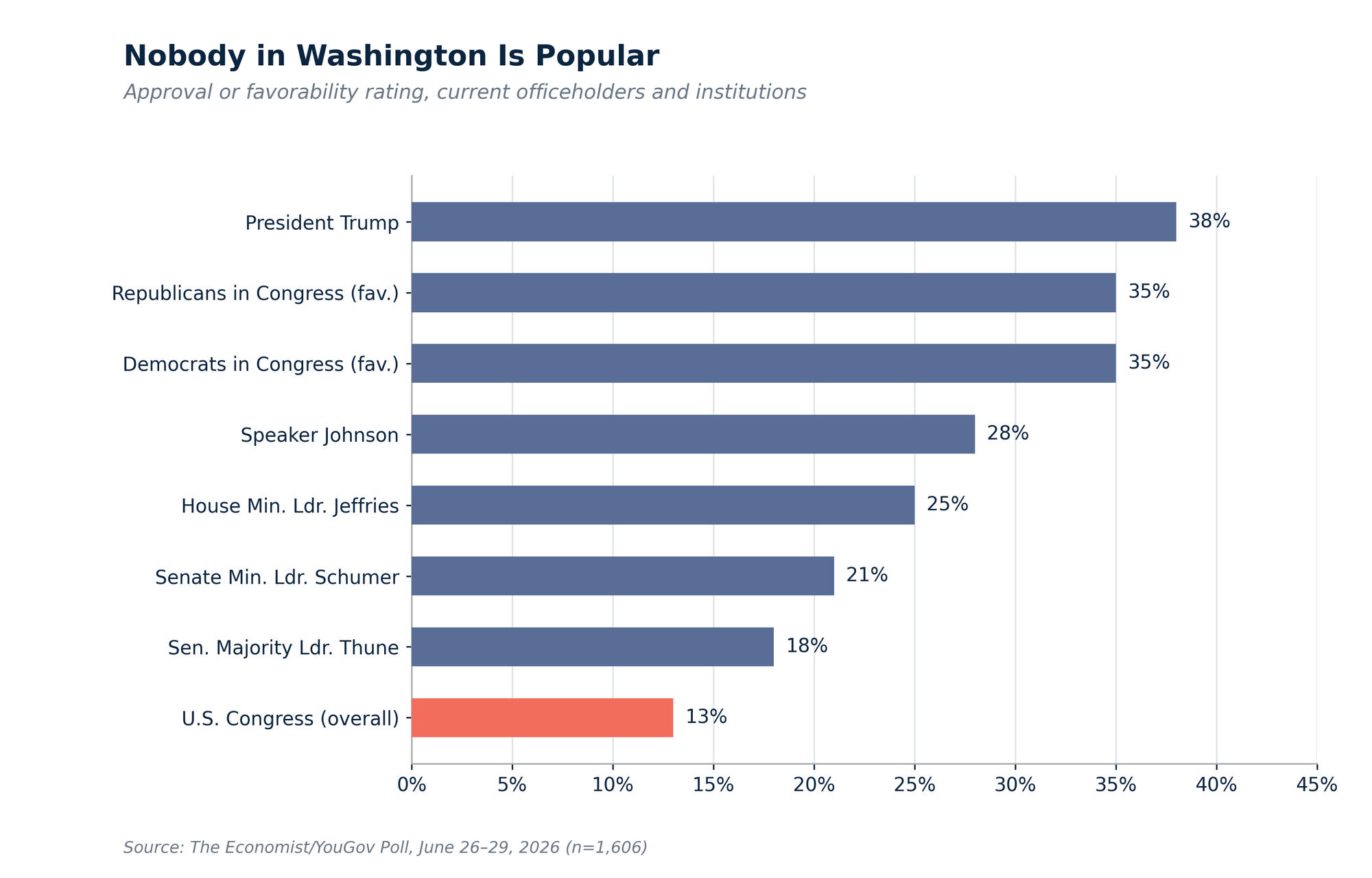
- Congress is disliked most
- Partisanship is the lens through which we view the future
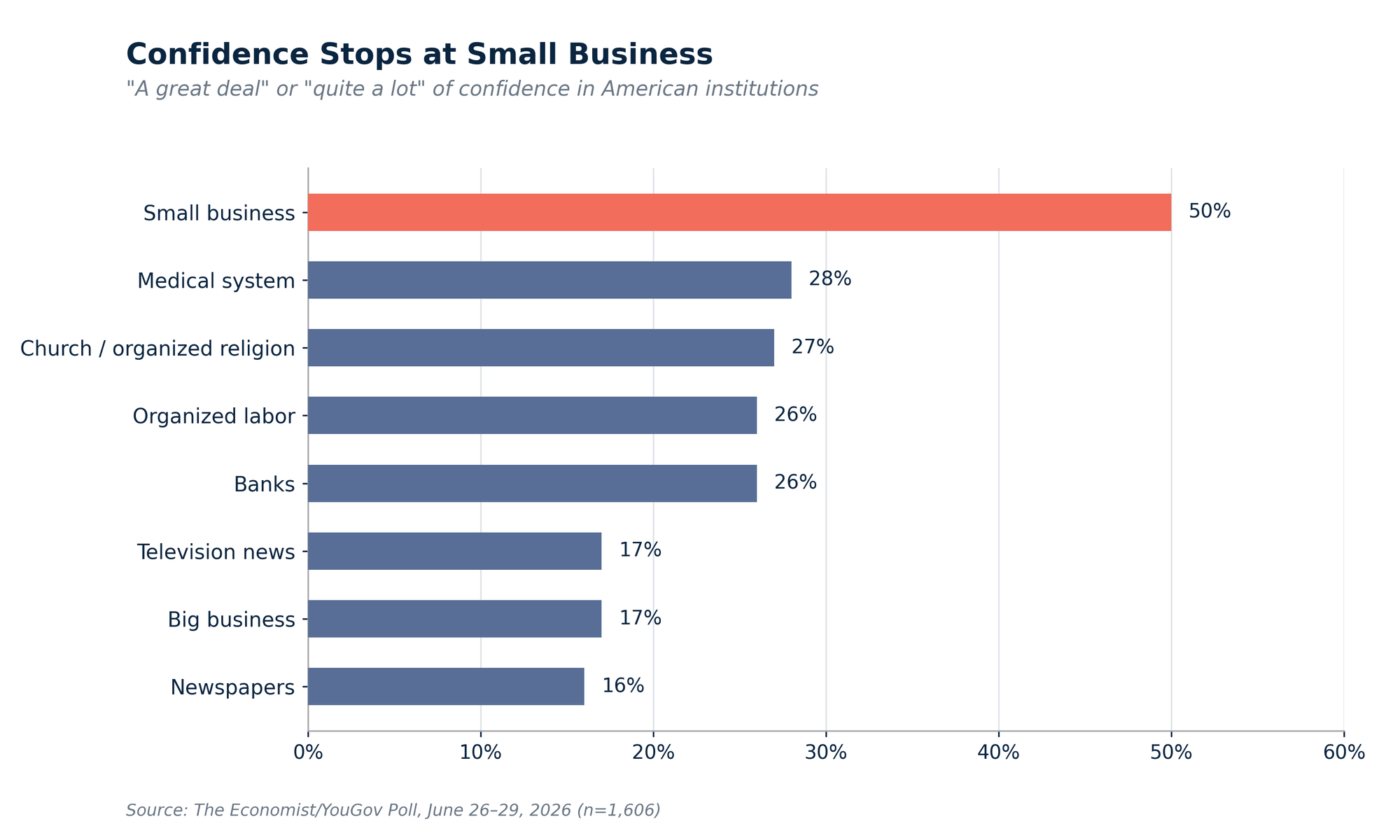
- Trust in the local merchant
- Everyone hates rising prices
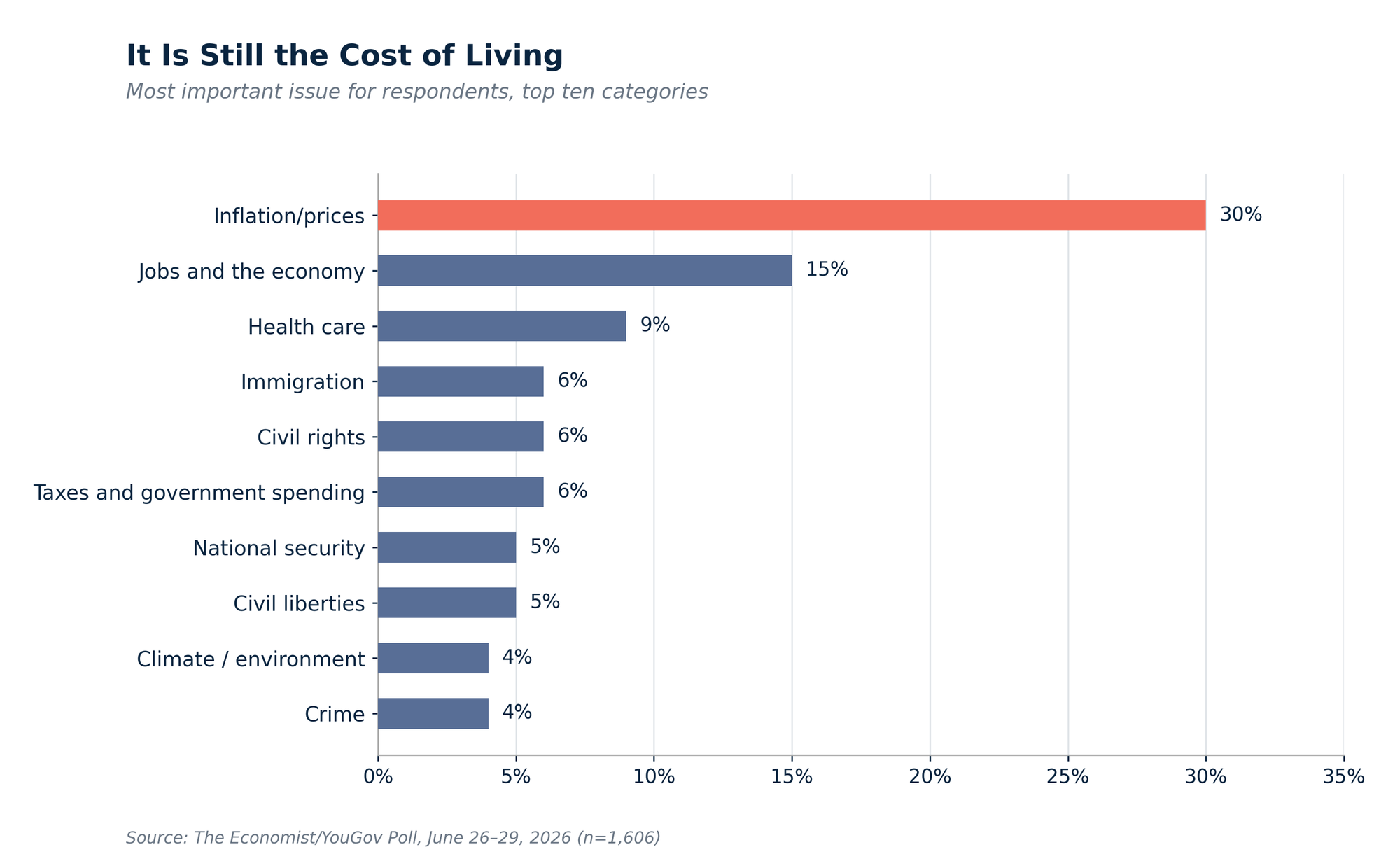
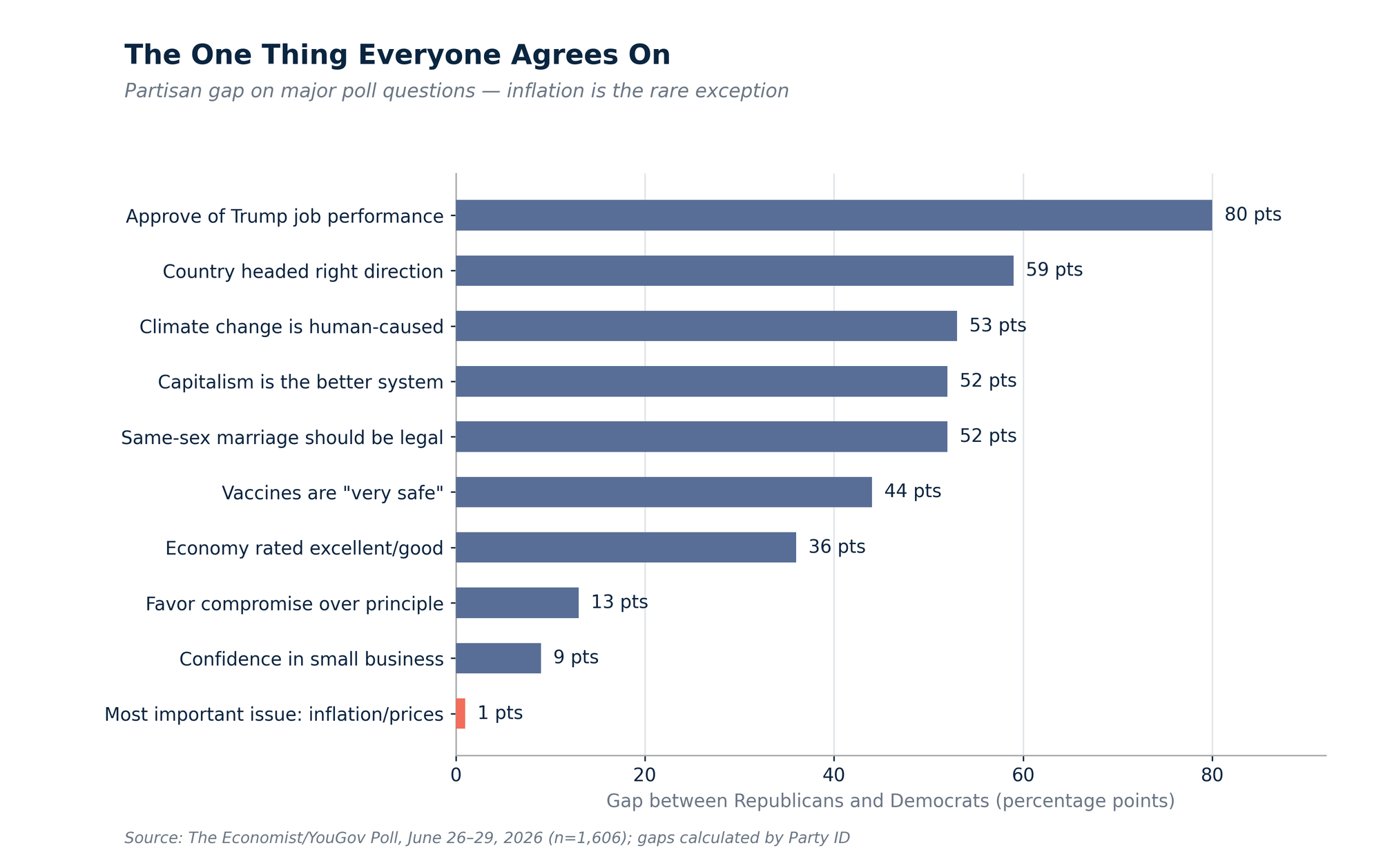
- Disagree on all but inflation