

Science: A New Golden Age, Michael Kratsios's July 2026 report to the President, claims to be the most serious official reckoning with the American research enterprise since Vannevar Bush's The Endless Frontier in 1945, the document it consciously seeks to succeed. Its diagnosis is strong and, in important respects, correct: the report marshals real evidence that the productivity of research has fallen, that administrative drag and consensus peer review suppress bold work, and that America's institutions still run on a 1950s template. Its process reforms are sound, and several are overdue.
However, the memo diverges from Bush's report on quality of analysis. The report treats spending parity as the frontier of the contest and treats foreign talent as an over-reliance to be reduced; in reality, the contest has already spread to outputs and the talent pipeline. America's dependence on imported minds is its least substitutable advantage, not a liability. The report also commits to protecting the basic-research base while proposing mechanism changes that could erode it in practice.
The Report at Its Best
A fair reading must begin with how much the report gets right, because its strongest arguments are better than its critics will admit.
Its diagnosis of stagnation is measured, not asserted. The report cites the economics directly: Bloom and co-authors' finding that sustaining Moore's Law now takes roughly eighteen times as many researchers as in the 1970s, an implied ~7% annual decline in "ideas productivity"; the pharmaceutical analogue, "Eroom's Law," in which R&D efficiency has fallen some eighty-fold since 1950; and NIH's budget doubling since the 1990s without a proportional rise in breakthroughs (pp. 13–14). Whatever one thinks of the remedy, this is a serious, sourced case that more money alone has stopped buying more discovery.
Its institutional analysis is genuinely novel for a government document. The report argues that discovery is recursive rather than linear, that private industry now performs a large and rising share of basic research, and that federal agencies still organize around the single-investigator university grant (pp. 5–7, 21–25). From this it builds a portfolio theory of grantmaking — matching mechanisms to problem types — with evidence behind each: person-based funding on the HHMI model, whose investigators produce high-impact work at roughly twice the rate of matched federal grantees; "golden tickets" that let a single reviewer champion non-consensus proposals; fast grants with 48-hour decisions; pull mechanisms like the DARPA Grand Challenge and the Vesuvius Challenge; and empowered metascience units running randomized experiments on the funding process itself (pp. 26–32). This is the most concrete menu of funding reform any administration has put on paper.
Two further arguments deserve credit. The manufacturing chapter's claim that offshoring erodes the tacit "process knowledge" that feeds back into science — grounded in Polanyi and illustrated by the instrument-building apprenticeship behind LIGO — is an intellectually serious case for reshoring that rises above jobs rhetoric (Chapter IV). And the AI chapter's insight that cheap generation raises the premium on verification — that science will need "a verifier equal in rigor and scale" as AI floods the literature — is a non-obvious framing of the reproducibility problem (pp. 64–66). On the merits, the report is often right.
Where the Argument Strains
The commitment to basic research is real; the mechanism risk is where to watch. To its credit, the report explicitly rejects defunding fundamental science — "quite the opposite" (p. 20) — and its FY2028 budget annex directs agencies to increase the share of foundational research relative to later-stage development, naming long-horizon basic work as the federal government's comparative advantage (p. 87). That is the right principle. The issue is in proposed execution. The same document proposes cutting indirect-cost recovery (NIH rates average above 40%, some negotiated at 50–60%) and redistributing toward person-based and non-institutional funding (pp. 8, 15). Overhead funds the shared laboratories, instruments, and technical staff that basic research requires. A reform that raises the headline "foundational share" while starving the institutional base that performs it would be a hollow victory. The goal is right; the plumbing is where it can go wrong.
"Permissionless innovation" is better hedged than its slogan, but still light on the hardest risk. The report does caveat that permissionless "does not mean the reckless development of technology," and favors regulatory sandboxes "with genuine accountability for results" (p. 38). Fair enough. But for a document this enthusiastic about synthetic biology, autonomous laboratories, and AI-accelerated discovery, the near-total absence of biosecurity or dual-use analysis is conspicuous. Its risk chapter is about epistemic integrity — bad papers, false findings — not about the physical misuse of the very capabilities it wants to unleash. That is a real gap, not a stylistic one.
The Public Origins of Private Triumphs
The report celebrates polio, Apollo, the human genome, the digital revolution, and general-purpose AI as proof of American greatness. Each was seeded by federal money, a point the report itself partly makes, and one worth pressing.
The internet descends from ARPANET, a DARPA program. GPS was built and is still operated by the Department of Defense. The Human Genome Project, by the report's own accounting, turned a $3.8 billion federal investment into an estimated $796 billion in economic activity (p. 44). The clearest case is the one the report leans on hardest: the mRNA platform behind the COVID-19 vaccines rested on decades of NIH-funded basic research1, a stabilized spike immunogen developed inside a federal laboratory, and an early $25 million DARPA bet on Moderna in 2013, years before any private market existed.2
Table 1 — The breakthroughs were public before they were private.
| Breakthrough | Federal origin | Private role |
|---|---|---|
| Internet | DARPA (ARPANET) | Commercialized decades later |
| GPS | U.S. Department of Defense | Consumer receivers on public signal |
| Human Genome Project | NIH + DOE, $3.8B → ~$796B (report, p. 44) | Downstream biotech industry |
| mRNA vaccines | NIH basic research; NIAID spike immunogen; $25M DARPA seed to Moderna (2013) | Manufacturing and scale-up |
Private industry is a formidable engine of translation, and the report is right to want it unleashed. But the sequencing matters: the triumphs it celebrates were public bets first — long-horizon, institution-scale, unrecoverable by any single firm at the moment they were made. That is the strongest reason to protect the institutional base in practice, not only in the budget annex. Reform the machine; fund the furnace that feeds it.
The Spending Has Crossed
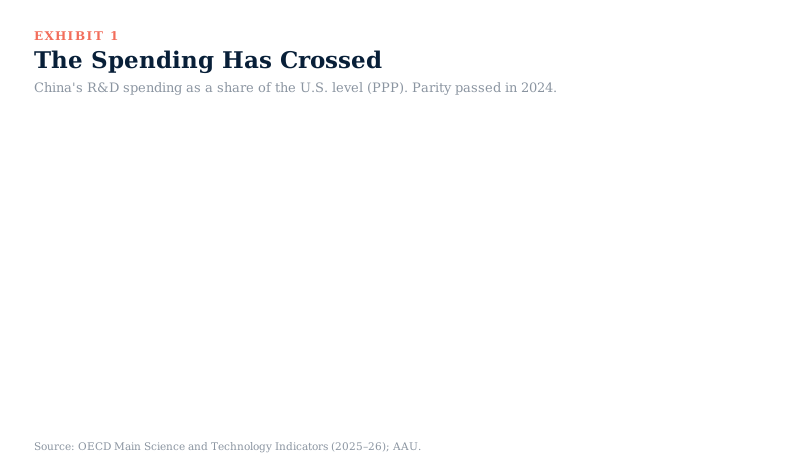
The report sees this one, and says so. Figure 2 (p. 9) shows Chinese R&D rising to parity with the United States on a purchasing-power basis, and the text calls China "a peer-level competitor in R&D spending... for the first time". Measured consistently in PPP terms, China's gross R&D expenditure rose from 72% of the U.S. level in 2013 to 96% in 2023 and edged past it in 2024, propelled by growth of roughly 8.7% a year against about 1.7% in the United States. In the government-funded segment, the public basic-research base, China now outspends the United States by about 1.6 to 1.3
The Output Has Crossed
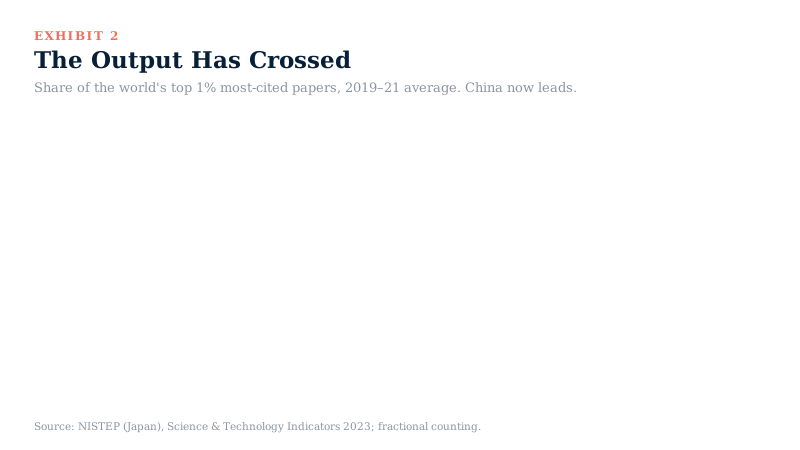
Here the report goes quiet. It quantifies China's inputs but not its results, and the results tell the sharper story. On the share of the world's top 1% most-cited papers, the closest proxy for frontier impact, China overtook the United States around 2019 and has held the lead, roughly 27% to 25%, by Japan's NISTEP accounting. In 2024 China also passed the United States in total scientific publications, the first displacement of American publication leadership since the United States overtook the United Kingdom in 1948.4
American elite institutions still cluster at the very top, and citation shares are imperfect. But a report premised on secure leadership should have confronted the output data, and it did not.
The Pipeline Has Crossed
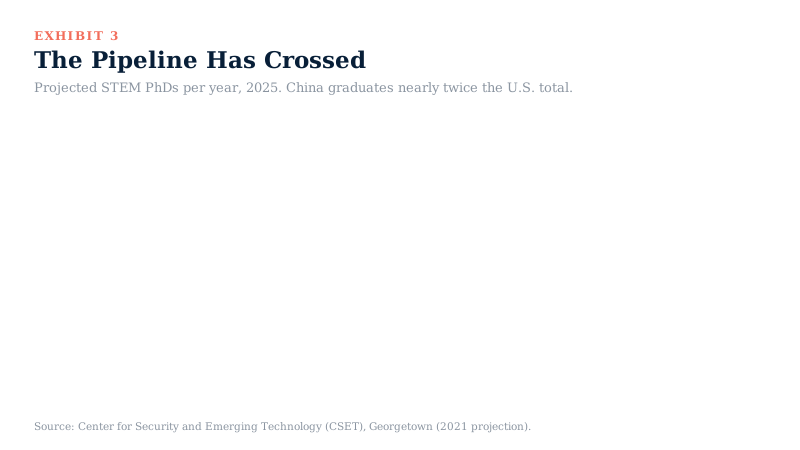
The talent pipeline is more lopsided still, and it compounds. On current enrollment patterns, China is projected to graduate roughly 77,000 STEM PhDs in 2025 against about 40,000 in the United States. Exclude international students from the American count, the students most exposed to visa policy, and Chinese STEM PhD output exceeds domestic U.S. output by more than three to one.5
America's Borrowed Edge
This is the interpretive crux, and the weak part of the report. The analysis does not ignore foreign talent; it confronts it and reaches the opposite conclusion. Noting that temporary visa holders account for roughly half of U.S. doctoral graduates in computer science and mathematics, it frames this as an "over-reliance" that "sidelines American students" and creates a security risk, and its remedy is inward: cultivate overlooked domestic talent and tighten research security (pp. 10–11). The impulse to develop American talent is right. The framing of foreign talent as primarily a vulnerability is not.
By NSF's accounting, foreign-born workers are about 19% of the total STEM workforce but 43% of doctorate-level scientists and engineers, 55% of doctorate engineers, and 58% of doctorate computer and mathematical scientists.6 Immigrants have founded or co-founded 59% of America's billion-dollar startups, roughly a quarter with a founder who arrived as an international student.7
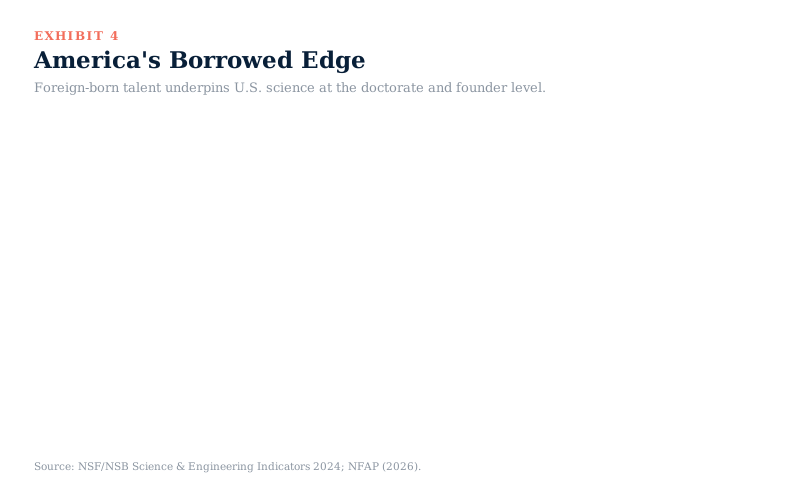
This is the true asymmetry with China. China can out-spend, out-publish, and out-graduate the United States, as Exhibits 1 through 3 show. What it cannot do is attract and retain the world's best minds from everywhere else. The U.S. five-year stay rate for foreign doctoral graduates sits near 71%, and around 88% for Chinese nationals trained in America. To treat that inflow chiefly as a leak to be plugged is to mistake the asset for the liability. Research security is a real problem and worth solving on its own terms, but a merit-based system, properly understood, exists precisely to capture the world's best regardless of where they were born. A talent strategy that treats immigration mainly as a risk has misread its own greatest advantage.
Opportunity and Risk on the Same Frontier
The report's AI-for-science agenda is its most forward-looking element and its most double-edged. The opportunity is real. The Genesis Mission (Executive Order 14363, November 2025) would wire DOE's seventeen national laboratories, their supercomputers, and their instruments into a single "discovery engine," with the stated aim of doubling the productivity of American science within a decade. If any initiative in the report could bend the productivity curve its diagnosis laments, this is it.
The risk sits in the same place. The report's own logic, that AI trained on a flawed knowledge base "will only entrench bad science," is correct, and its "Gold Standard Science" emphasis on reproducibility and verification is welcome. But it treats verification as a technical fix rather than a strategic bottleneck: as generation gets cheap and verification stays expensive, the binding constraint becomes trust in results, an institutional problem before a computational one. And by encoding the agenda in contested political language — "Gold Standard Science," "political fashions of the day" — the report makes its own reforms easy for a successor to reverse. Reversibility is the enemy of the long horizons it rightly wants to protect. The AI agenda's largest risk is not technical failure. It is that verification, trust, and continuity fail to keep pace with generation.
Implications
For the Administration, sequencing should matter more than slogans. The process reforms, including portable fellowships, fast grants, metascience, burden reduction, should proceed. The mechanism changes that touch indirect costs and institutional funding should be piloted and measured before scaling, so that a rising "foundational share" does not come at the cost of the labs that perform the work.
For Congress and appropriators, the China data reframe the budget question. The issue is not whether to sustain federal research but whether the United States can afford the relative decline that ~1.7% real growth implies against a competitor compounding near 8.7%.
For immigration and visa policy, the talent data are decisive and cut against the report's framing. High-skill immigration is core industrial policy, not an adjacent social question; the stay rate is the asset, and research-security tools should be sharpened without blunting it.
For universities and industry, the report's recoupling of discovery and manufacturing is its most durable contribution — where private capital, federal infrastructure, and regional workforce policy reinforce one another, and where the report is both original and right.
What to Watch
Four variables will confirm or break this reading. First, the FY2028 budget: whether the promised rise in foundational-research share survives the simultaneous cuts to indirect costs, or whether the base erodes in practice. Second, the China trajectory: whether U.S. R&D growth accelerates off its ~1.7% floor, or whether the crossover widens across output and talent. Third, high-skill visa policy: whether the stay rate holds, or whether a security-first framing erodes the borrowed edge. Fourth, the durability test: whether the Genesis Mission and "Gold Standard Science" survive the next election, revealing whether they were built as institutions or as gestures.
Kratsios has drafted a serious, often-compelling reform program. But on the three questions that set the strategy, the report sees the right facts and misjudges them. It concedes spending parity yet treats spending as the frontier, when the contest has already spread to output and talent. It commits to basic research on paper while proposing mechanism changes that could hollow the base in practice. And it correctly notes America's dependence on foreign-born scientists, then reads that dependence backwards: as a vulnerability to reduce rather than the one advantage no competitor can copy. A golden age is still available. It will be reached by funding the furnace that forged the last one, by contesting the whole race rather than its opening leg, and by keeping open the doors through which America's talent has always arrived.